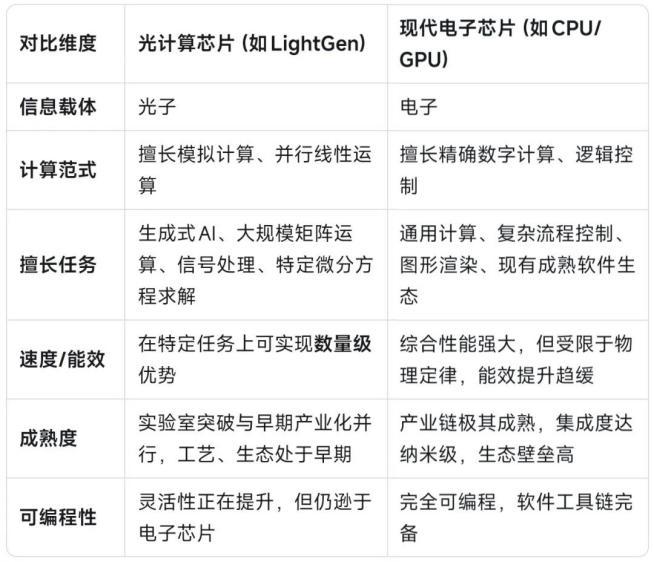
传统电子芯片面临功耗墙、内存墙、带宽墙的制约,光计算正成为突破算力瓶颈的新方向1。在2026年WAIC大会上,国内光本位科技、曦智科技、每刻深思等企业集中展示了光计算芯片的最新成果1。其中,光本位科技宣布成功流片256×256矩阵规模的光子存内计算芯片,该芯片为全球算力密度最大和算力精度最高的光计算芯片1。曦智科技在2024年至2025年光计算芯片出货量连续两年位居全球第一1。美国企业Lightmatter的Envise处理器拥有256个RISC内核,提供400Gbps的芯片间互连带宽1。
学术界也在这一领域取得突破。清华团队2024年研制了全球首款大规模干涉衍射异构集成芯片太极(Taichi),实现160 TOPS/W的通用智能计算1。中科院上海光学精密机械研究所2025年6月研发了"流星一号"超高并行光计算集成芯片1。上海交通大学2024年12月首次实现支持大规模语义媒体生成模型的全光计算芯片LightGen1。
然而,尽管这些成果令人瞩目,光计算芯片产业目前仅处于小规模试点商用阶段,尚未达到大规模量产水平1。工艺良率、软件生态、产业链配套等因素仍是制约因素1。在Transformer主导的AI时代,矩阵乘法占据总计算量的七成以上1,这使得光计算芯片在AI应用中具有较强的适配潜力,但产业化之路仍需突破现有的技术和生态瓶颈。
As traditional electronic chips face constraints from power consumption, memory bandwidth, and latency bottlenecks, optical computing has emerged as a promising avenue to break through computational performance limits 1. At the 2026 WAIC conference, several Chinese optical computing companies, including Guangbenyuan Technology, Xizhi Technologies, and Moke Deep Thought, showcased their latest achievements in the field 1. However, the industry remains in an early commercialization stage with limited pilot deployments, not yet reaching mass production scale, as companies grapple with challenges including manufacturing yield rates, software ecosystems, and supply chain integration 1.
Among recent breakthroughs, Guangbenyuan Technology announced the successful development of a 256×256 matrix-scale photonic in-memory computing chip, which the company claims represents the highest computing density and precision globally 1. Meanwhile, Xizhi Technologies has captured the top position in global optical computing chip shipments for two consecutive years, 2024 and 2025 1. International progress has also been notable: Lightmatter's Envise processor features 256 RISC cores and delivers 400 Gbps inter-chip bandwidth 1. Recent academic advances include Tsinghua University's demonstration of the first large-scale heterogeneous interference diffraction integrated chip, Taichi, which achieved 160 TOPS/W for general-purpose intelligent computing in 2024 1, and Shanghai Jiao Tong University's successful implementation of LightGen, the first all-optical computing chip supporting large-scale semantic generative AI models, in December 2024 1. The Shanghai Institute of Optics and Fine Mechanics under the Chinese Academy of Sciences developed the Meteor-1 ultra-parallel optical computing integrated chip in June 2025 1. Given that matrix multiplication accounts for over 70% of total computation in the Transformer-dominated AI era, optical computing's potential for accelerating AI workloads has become increasingly apparent 1.
评论
还没有评论,欢迎留下第一条。