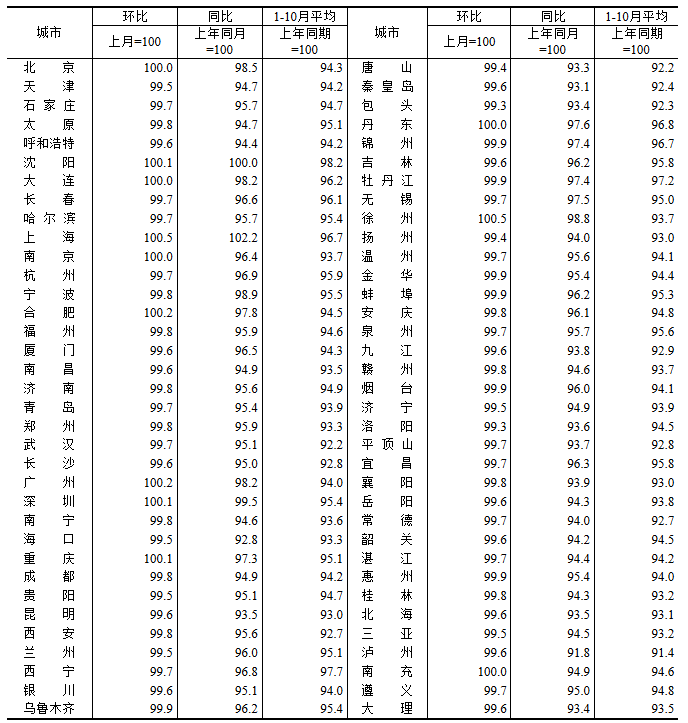
2026年11月16日,国家统计局公布的70个大中城市商品住宅销售价格数据显示,中国房地产市场呈现显著的结构性分化态势1。其中,一线城市二手住宅销售价格环比上涨0.2%,涨幅与上月相同,这是连续第8个月环比上涨1。具体来看,上海、广州和深圳的二手住宅销售价格分别上涨0.5%、0.2%和0.1%,北京则保持持平1。
成交量方面,10月份全国二手房网签同比上涨18.9%,自3月份以来已连续8个月同比上涨1。上海10月二手网签2.47万套,同比增长33%,创近六年同期新高;北京二手住宅网签1.3万套,同比增长8.2%1。供给端显示挂牌量减少:截至9月末,北京主要中介挂牌房源较年初下降12%,武汉二手挂牌同比减少19%1;四个一线城市9月末挂牌量合计41.18万套,较4月末的42.53万套减少1.35万套,降幅3.19%1。
与二手房市场不同,新房市场因开发商去库存压力采取“以价换量”策略,价格表现疲软1。2026年10月,一线城市新建商品住宅销售价格环比由上月上涨0.1%转为持平,其中北京下降0.1%1。二线城市新建商品住宅销售价格环比由上月持平转为下降0.1%,三线城市下降0.2%1。分析师指出,“二手房强于新房”的结构分化格局预计将延续至明年1。
China’s first-tier cities recorded a 0.2% month-on-month increase in second-hand housing prices in October 2026, marking the eighth consecutive month of gains 1. This upward trend contrasts with the new home market, where developers have continued to prioritize inventory reduction through price concessions, resulting in flat or slightly declining values across major urban centers 1. The divergence highlights a structural shift in buyer preferences and developer strategies as year-end approaches 1.
Detailed city-level data reveals that Shanghai led the growth with a 0.5% rise, followed by Guangzhou at 0.2% and Shenzhen at 0.1%, while Beijing remained unchanged 1. Transaction volumes surged alongside these price movements, with Shanghai logging 24,700 online-signed second-hand deals in October, a 33% year-on-year jump that represents the highest volume for the same period in nearly six years 1. In Beijing, second-hand home transactions reached 13,000 units, reflecting an 8.2% annual increase 1. Nationally, second-hand home signings rose 18.9% year-on-year in October, continuing an eight-month streak of annual growth since March 1.
The tightening supply has further supported resale prices, with listing volumes dropping significantly in key markets. By the end of September, listings from major agencies in Beijing had fallen 12% compared to the beginning of the year, while Wuhan saw a 19% year-on-year decline 1. Across the four first-tier cities, total listings stood at 411,800 units at the end of September, down by 13,500 units or 3.19% from the April peak 1. Conversely, the new home market showed signs of cooling pressure; first-tier city new commodity housing prices stabilized in October after rising 0.1% the previous month, with Beijing specifically seeing a 0.1% dip 1. Second-tier cities experienced a shift from stability to a 0.1% monthly decline, while third-tier cities dropped by 0.2% 1. Analysts predict that this pattern of second-hand outperforming new homes will persist into next year 1.
评论
还没有评论,欢迎留下第一条。