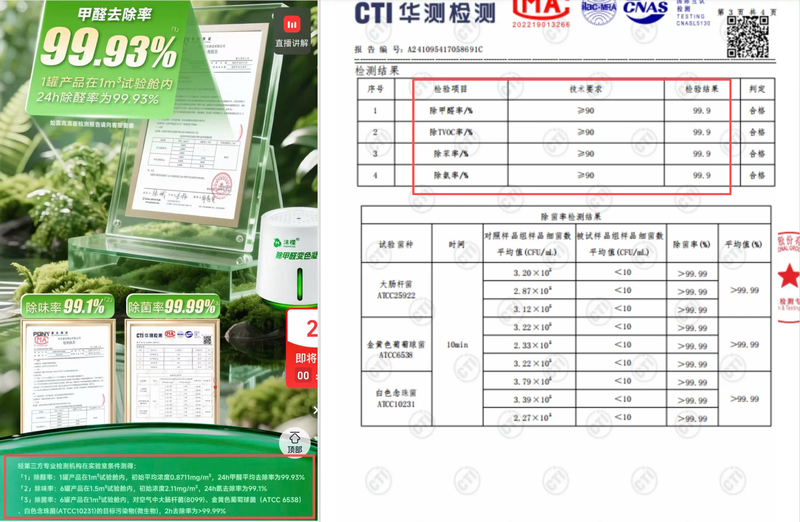
新京报消费研究院调查发现,除甲醛凝胶产品存在系统性虚假宣传乱象1。沫檬品牌宣称99.93%除醛率,绿之源产品宣传24小时除醛率达99%,但这些数据均源自微型试验舱的极限条件1。其中沫檬的测试条件为1立方米试验舱内放置1罐产品24小时测得,绿之源则为1.5立方米试验舱、3罐产品的环境1。与此形成对比的是,老爸评测在30立方米标准模拟居家试验舱内进行的实际测试显示,多款产品24小时除醛率仅为10%-12%1。
部分品牌还存在虚构资质和误导性标榜的问题1。doscoo旗舰店产品页面宣传标出清华大学、北京大学、三甲医院认证,但客服无法提供确切关联信息1。好安科则自称为澳洲进口品牌,客服却表示产品采用进口技术在国内生产1。律师指出,这些行为涉嫌虚假广告,违反《广告法》第十一条、第九条、第二十八条和《消费者权益保护法》的相关规定1。
国内暂无除醛凝胶专项国家标准,产品多执行企业自主标准1。涉事企业临沂展月启商贸有限公司因无法联系已被列入经营异常名录,山东省临沂市兰山区市场监督管理局已对此立案调查1。
An investigation by Beijing News has uncovered widespread false advertising in the formaldehyde-removal gel product market.1 Brands including Moemon, Lvzhiyuan, doscoo, and Hao'an Science claim remarkably high formaldehyde removal rates, yet these figures are derived from controlled laboratory conditions far removed from actual home environments.1
Moemon advertises a 99.93% formaldehyde removal rate based on testing a single unit of product in a 1 cubic meter chamber over 24 hours, while Lvzhiyuan claims 99% removal under similarly limited conditions using 1.5 cubic meters and three product units.1 In contrast, testing conducted in a 30 cubic meter standardized simulated home environment revealed that multiple products achieved actual removal rates of only 10% to 12% over 24 hours.1
Beyond inflated efficacy claims, manufacturers have engaged in misleading marketing practices. doscoo's flagship store displays references to Tsinghua University, Peking University, and Class-A hospitals as certifying bodies, though customer service representatives cannot provide concrete evidence of such affiliations.1 Hao'an Science promotes itself as an Australian imported brand, yet company representatives admit the products are manufactured domestically using imported technology.1 Legal experts have indicated that such practices violate the Advertising Law and Consumer Protection Law of the People's Republic of China, specifically breaching provisions prohibiting false data, absolute claims, and deceptive product performance representations.1
Regulatory challenges compound the problem. China currently lacks specialized national standards for formaldehyde-removal gels, leaving products to follow only their own proprietary corporate standards.1 One manufacturer, Linyi Zhangyue Qishang Trading Company, has been listed in the business abnormality registry due to being unreachable, while the Market Supervision and Management Bureau of Lanshan District in Linyi, Shandong Province has initiated an investigation.1
评论
还没有评论,欢迎留下第一条。