研究人员通过3D扫描技术分析了塔斯马尼亚虎的头骨结构,发现这一已灭绝物种具有独特的捕食适应特征1。研究表明,塔斯马尼亚虎虽然体重仅约17公斤,但其头骨大小与体重超过其两倍的狼相当1。这种头身比例不匹配的特征,结合其细长但超大的下颌结构,使该物种能够以高速进行快速咬合捕猎1。
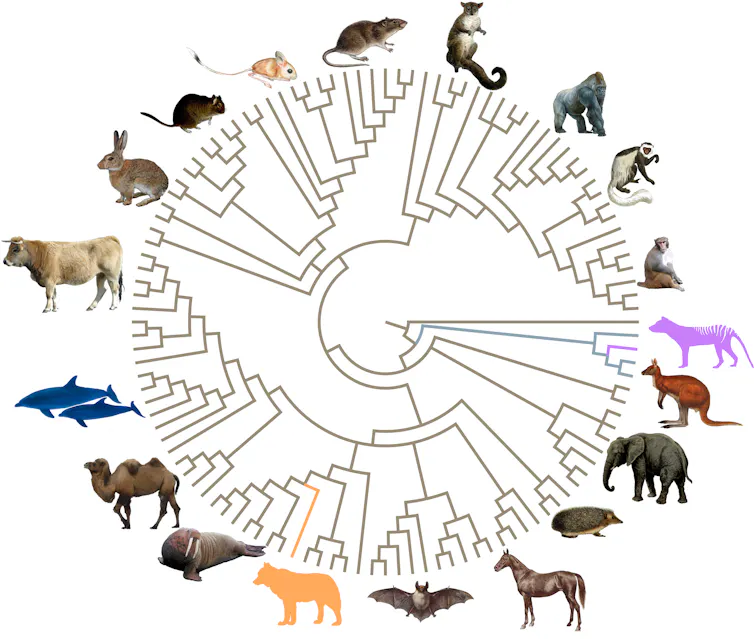
这些解剖学特征与鳄鱼的捕食方式相似,表明塔斯马尼亚虎在现代捕食哺乳动物中独一无二1。研究还发现塔斯马尼亚虎上颌骨呈独特的"沙漏形"1。由于塔斯马尼亚虎与狗类相隔1.2亿年的进化时间1,这些捕食适应特征代表了哺乳动物咬合机制的一条独立演化路线。相关研究已发表在《Nature Communications》期刊1。塔斯马尼亚虎最后一只已知个体去世距今已有90年1。
Researchers analyzing three-dimensional scans of the Tasmanian tiger's skull have uncovered a distinctive predatory adaptation previously unknown in modern mammals.1 The extinct marsupial possessed an unusually elongated lower jaw paired with a disproportionately massive skull that enabled it to execute high-speed snapping bites, a hunting mechanism comparable to that of crocodiles.1 Despite weighing only about 17 kilograms, the Tasmanian tiger's skull was as large as that of wolves weighing more than twice its body mass.1
The research team, including Vera Weisbecker, Andrew Pask, and Douglass S Rovinsky, documented these findings in a study published in Nature Communications.1 The upper jaw exhibited a distinctive hourglass shape, contributing to the animal's unique feeding mechanics among predatory mammals.1 Having diverged from canine species approximately 120 million years ago, the Tasmanian tiger represented a remarkably specialized hunting design that evolved independently.1
The last known individual of this species died 90 years ago.1 Australia continues to experience the world's highest rate of mammalian extinction.1
评论
还没有评论,欢迎留下第一条。