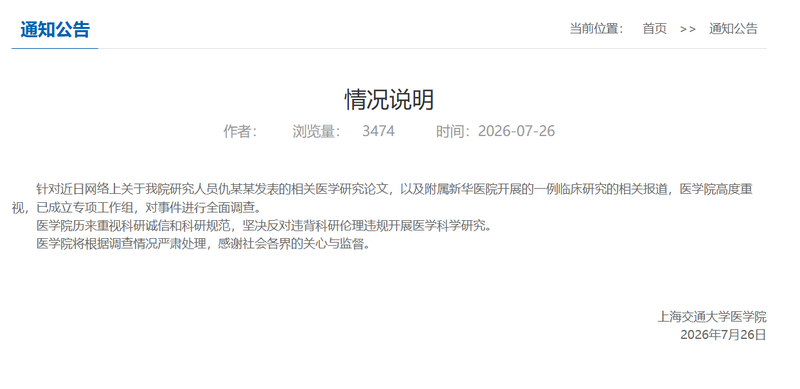
上海交通大学医学院附属新华医院为患有Snijders Blok-Campeau综合征的6岁女童小美进行全球首例脑部碱基编辑治疗试验1。该患儿患有轻度发育迟缓和语言障碍2,其生命安全并未面临即时威胁2。2025年3月24日进行治疗后的第7天,小美因血栓性微血管病去世1。医院伦理委员会认定死亡与治疗肯定相关1。
试验前的安全评估存在重大缺陷。医院伦理委员会在2025年1月批准了临床试验申请2,但完整的灵长类动物毒理学数据直到一个月后才出具2。该报告显示4只猴子均出现中度至重度肝损伤,其中一只高剂量组出现肾损伤1。家属为承担病毒制备和治疗相关费用自筹近600万元1。这场试验暴露出临床前安全评估缺陷、伦理审查不足、对风险评估过度乐观等多处问题1。
国家科技伦理委员会委员翟晓梅指出,伦理审查委员会缺乏专业能力、风险评估不当、知情同意不充分2。她强调,任何对科研和学术成果的追求都不能凌驾于受试者生命安全之上2。此后,临床试验平台在2025年7月30日宣布停止招募,标注为严重不良事件1。相关研究论文于2026年2月在《自然》杂志发表,但未披露患者死亡1,《自然》杂志在2025年7月29日增加了编辑注记,质疑论文及数据1。为防止类似悲剧重演,国家颁布了《生物医学新技术临床研究和临床转化应用管理条例》,该条例于2026年5月1日起正式实施2。
A groundbreaking yet tragic clinical trial at Shanghai Jiao Tong University School of Medicine's Xinhua Hospital has raised serious questions about ethical oversight in cutting-edge biomedical research. A six-year-old girl named Xiaomei underwent experimental brain base editing therapy on March 24, 2025, but died seven days later from thrombotic microangiopathy 12. The hospital's ethics committee determined that her death was "definitively related to the treatment" 12.
Xiaomei suffered from Snijders Blok-Campeau syndrome, a rare condition affecting only approximately 237 known patients worldwide 1. The experimental procedure employed two sets of adeno-associated viral (AAV) vectors for brain base editing 1. However, critical safety concerns preceded the treatment. Animal toxicology studies conducted on four primates revealed moderate to severe liver damage in all subjects, with one monkey in the high-dose group also experiencing kidney injury; these results were issued on February 17, 2025 1. Despite these findings, the hospital's ethics committee approved the clinical trial application in January 2025, before the complete toxicology data was available 12.
The case exposed multiple systemic failures in the approval process. Xiaomei's condition—characterized by mild developmental delay and language difficulties—posed no immediate threat to her life 2, yet she was enrolled in an experimental protocol. The family self-funded approximately 6 million yuan for virus preparation and treatment costs 12. A paper describing the trial was published in Nature magazine in February 2026 without disclosing the patient's death 1. When Nature issued an editorial note questioning the paper and its data on July 29, 2025, the clinical trial platform announced a halt to new enrollment on July 30, 2025, marking the incident as a serious adverse event 1.
Zhai Xiaomei, a member of China's National Committee for Science and Technology Ethics, emphasized that ethical review committees lack adequate professional capacity for assessing such complex trials, and that risk evaluations were overly optimistic 2. She stressed: "No pursuit of scientific and academic achievement can supersede the protection of research subjects' lives" 2. In response to the tragedy, China promulgated the Regulations on Clinical Research and Clinical Transformation Applications of Biomedical New Technologies (Decree 818), with full implementation beginning May 1, 2026 2.
评论
还没有评论,欢迎留下第一条。