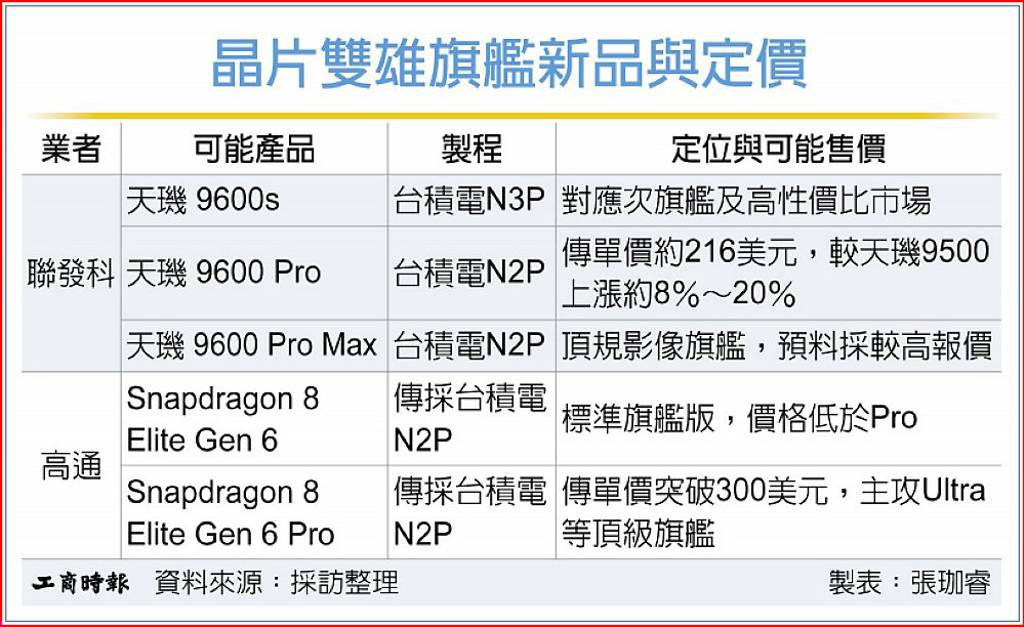
下一代旗舰芯片的成本压力正在重塑安卓手机市场格局。高通骁龙8 Elite Gen 6 Pro的报价超过300美元(约2030元人民币),联发科天玑9600 Pro则约为216美元(约1461元人民币),这些核心芯片的成本大幅上升。1当与LPDDR6内存、UFS 5.0闪存等存储部件结合时,这三大件的总成本已达600美元(约4060元人民币),严重压缩了安卓旗舰手机的利润空间。1
为了应对成本压力,高通和联发科等芯片厂商正在采取与苹果类似的分级策略。1两家公司分别采用N3P和N2P工艺推出标准版和Pro版旗舰芯片,以在维持产品竞争力的同时控制制造成本。1值得注意的是,N2P工艺相比N3P的性能提升仅为10%-15%,但功耗得以降低20%-25%,这种递减的制程升级收益正在激发国产芯片在AI加速、架构设计等新维度开拓创新的空间。1
Next-generation flagship chips are commanding unprecedented prices, with Qualcomm's Snapdragon 8 Elite Gen 6 Pro priced above $300 (approximately 2,030 yuan) and MediaTek's Dimensity 9600 Pro around $216 (roughly 1,461 yuan).1 The combined cost of cutting-edge components—2nm chipsets, LPDDR6 memory, and UFS 5.0 storage—reaches approximately $600 (over 4,060 yuan), severely compressing profit margins on Android flagship devices.1
This cost pressure is forcing manufacturers to adopt a tiered chip strategy. Both Qualcomm and MediaTek are now rolling out standard and Pro versions of their flagship processors, utilizing N3P and N2P manufacturing processes respectively.1 The performance gains from the more advanced N2P process are modest, delivering only 10–15% improvement while reducing power consumption by 20–25%.1 For context, the iPhone 17 Pro Max carries hardware costs of $535 (under 4,000 yuan) while retailing at 9,999 yuan, whereas Samsung's S26 Ultra costs 600–650 dollars (over 4,000 yuan) at the same 9,999 yuan price point.1 As diminishing returns from process technology improvements become apparent, domestic chip designers are increasingly exploring differentiation through AI acceleration and architectural innovation.1
评论
还没有评论,欢迎留下第一条。