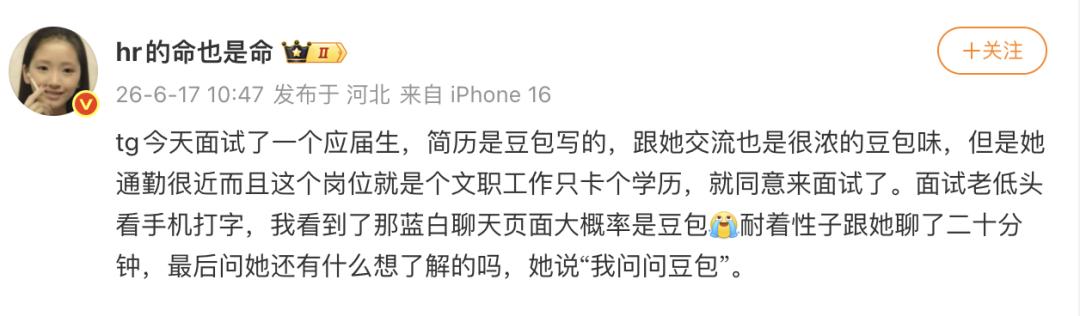
应届生求职中对AI工具的依赖程度正在快速上升。2025年,66.7%的校招生求职时使用了AI;到2026年,这一比例预计将达到95%。1北森AI人才科学研究院发布的《AI原生求职时代》报告指出,当前求职市场存在严重的同质化现象,"人人都有大厂实习,人人都是项目负责人"。1与此同时,企业也在加快采纳AI面试技术来适应这一变化。过去一年,使用AI面试官的企业数量同比增长了4倍,其中84%的应用集中在校园招聘环节。1
在AI技术双方共同使用的背景下,求职竞争的焦点正在发生转变。长安汽车引入AI面试官后,人机判断的一致性达到70%至80%,复试通过率提升了20%,一季度校招因此节省了8333个小时。1晶合集成的简历筛选效率提升了39%,录用率也从45%上升到65%。1Zapier招聘经理邦妮·迪柏表示,在审核的申请中至少四分之一一眼就能看出是AI产物。1这种同质化现象与应届生的申请数量增加密切相关——2025年提及AI的实习岗位平均收到78份申请,即便是非AI岗位也有32份。1
经济学家迈克尔·斯宾塞在1973年提出的观点至今仍有启示意义,他认为递交简历的本质是花时间和精力向雇主表明"我值得被面试"。1如今,当简历的措辞和包装日益同质化时,真正的竞争力已经从简历文字阶段转移到了面试追问环节,求职者需要具备经得起深度追问的真实工作经历和判断力才能脱颖而出。1
The widespread adoption of artificial intelligence in job application preparation is creating increasingly uniform resumes among recent graduates, fundamentally reshaping how employers evaluate candidates. In 2025, 66.7% of campus recruits used AI to craft their job applications, with projections suggesting this figure will reach 95% by 2026 1. According to the "AI-Native Job Search Era" report from Beisen AI Talent Science Research Institute, the result is a labor market where "everyone claims large-company internships and everyone presents themselves as project leaders" 1.
To counter this homogenization, enterprises are deploying AI interview systems at an accelerating pace. The number of companies using AI interviewers has surged fourfold over the past year, with 84% of these implementations focused on campus recruitment 1. Chang'an Automobile, for instance, achieved 70–80% consistency between human and machine assessments after integrating an AI interviewer, raising their second-round pass rate by 20% and saving 8,333 hours during first-quarter recruiting 1. Similarly, Jinghe Integrated Circuits improved resume screening efficiency by 39%, with their hiring rate climbing from 45% to 65% 1.
The economic consequence is intensifying competition despite technological efficiency gains. China's universities are projected to graduate over 12 million students in 2026, with an employment rate around 65% 1. Campus recruiting positions mentioning AI received an average of 78 applications in 2025, compared to 32 applications for non-AI roles 1. As economist Michael Spence noted in 1973, submitting a resume fundamentally represents spending time and effort to signal to employers that "I deserve an interview" 1.
With AI neutralizing both sides of the screening process, genuine competitive advantage has shifted from resume wording to the interview interrogation phase. Candidates now require authentic work experience and sound judgment that can withstand rigorous questioning—qualities that cannot be easily replicated by generative tools. A Zapier recruitment manager, Bonnie Dibner, noted that at least one-quarter of applications she reviews are obviously AI-generated at first glance 1.
评论
还没有评论,欢迎留下第一条。