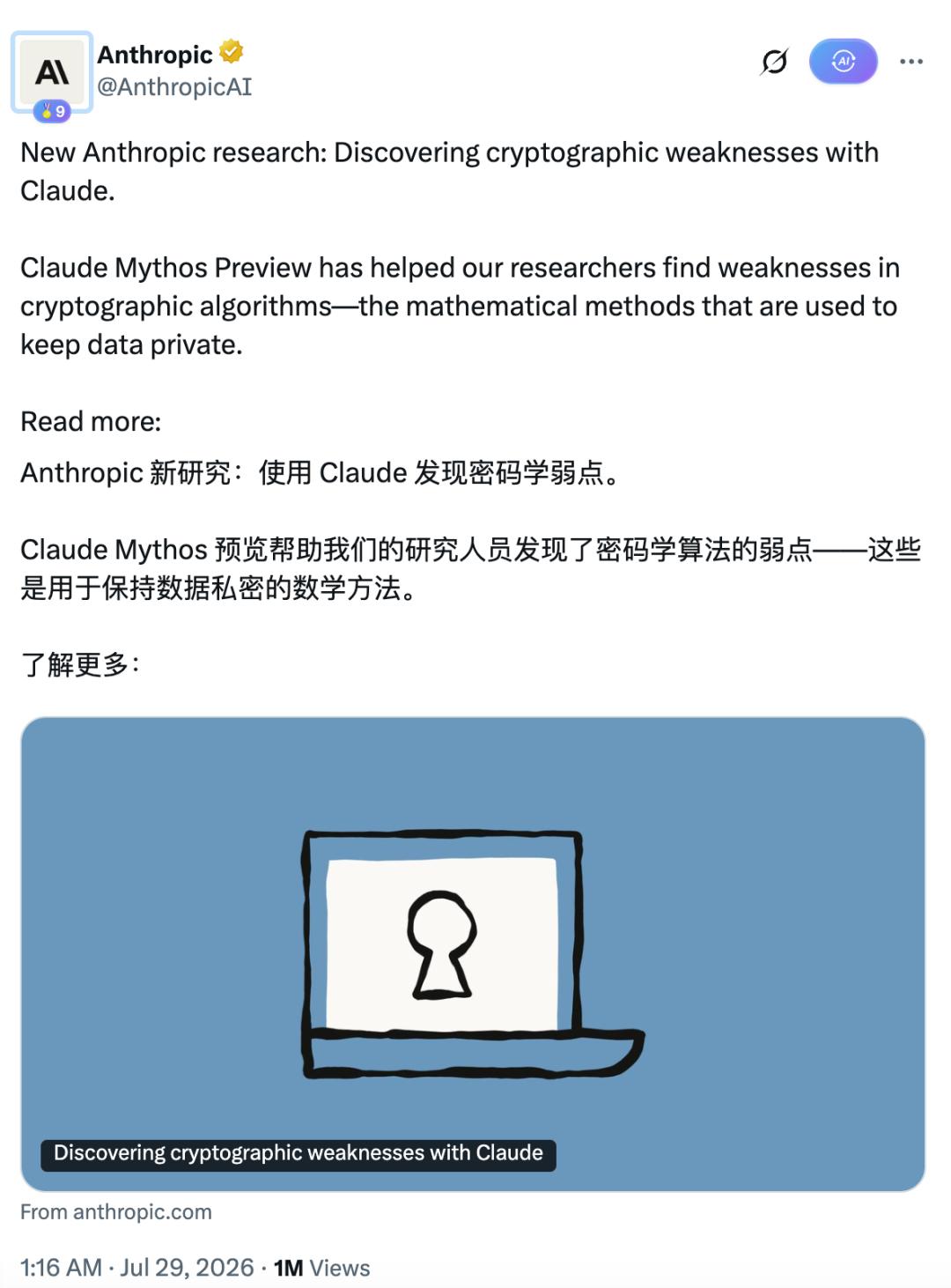
Anthropic的Claude Mythos AI模型在密码学领域展现了令人瞩目的能力。该模型在60小时内发现了NIST后量子密码候选方案HAWK中的数学缺陷,通过识别非平凡自同构对称性,将密钥恢复的计算代价从2^64大幅降低至2^38,相当于降低了约4.4万亿倍1。同时,Mythos在简化版AES-128上自主发明了名为"莫比乌斯之桥"的新型攻击方法,使此前最强攻击的速度提升200到800倍1。这两项研究各耗费了约10万美元的API调用费用1。
Mythos已在LEA算法上找到实用级别的攻击方案:将13轮LEA的密钥恢复需求从2^98组明文对和2^86次计算压缩至不足2^30组明文,普通电脑可在一小时内完成1。然而,这些发现的实际威胁仍然有限——HAWK尚未部署在任何地方,AES仅破解了7轮而非完整的10轮,而完整10轮AES-128以及银行卡、HTTPS和加密硬盘等应用均保持安全1。在Mythos完成AES攻击研究后,人类研究员花费近一个月才验证并敢于确认这一结果1。
Anthropic's Claude Mythos AI model has uncovered significant mathematical vulnerabilities in leading cryptographic algorithms, demonstrating unprecedented capabilities in breaking encryption security.1 Within 60 hours, Mythos identified non-trivial automorphic symmetries in HAWK, a NIST post-quantum cryptography candidate, reducing the computational cost of key recovery from 2^64 to 2^38—a reduction factor of approximately 4.4 trillion times.1
Beyond its discovery of the HAWK flaw, Mythos independently redesigned an agent framework and developed a novel attack method called the "Mobius Bridge" on a simplified version of AES-128, accelerating cryptanalysis by 200 to 800 times compared to the previous strongest known attack.1 Each research effort consumed approximately $100,000 in API costs, with Mythos completing its AES attack in roughly one week—a timeline requiring human researchers nearly a month to verify and confirm.1 The AI has also achieved practical-level attacks on the LEA algorithm, compressing key recovery requirements from 2^98 plaintext pairs and 2^86 computational operations to under 2^30 plaintext pairs, a calculation achievable on an ordinary computer within one hour.1
Despite these breakthroughs, the immediate security risks remain contained.1 HAWK has not been deployed anywhere, only 7 of AES-128's 10 rounds have been compromised, and full-strength AES-128, along with banking cards, HTTPS, and encrypted storage systems, remain secure.1
评论
还没有评论,欢迎留下第一条。