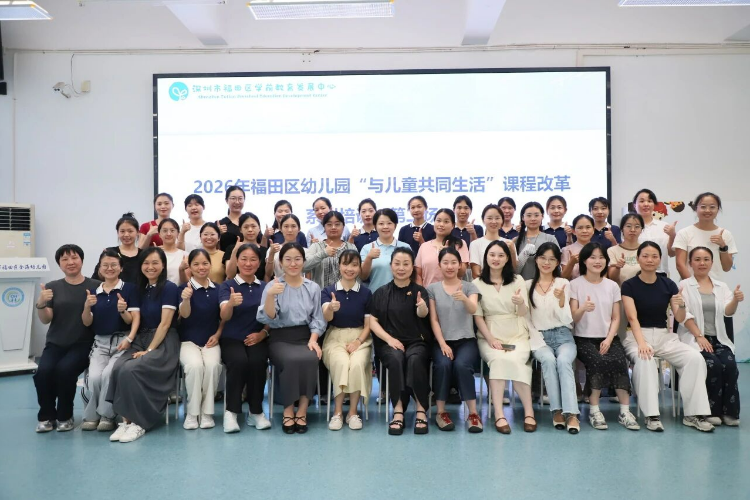
深圳市福田区幼儿园近日组织开展"与儿童共同生活"课程改革系列培训,邀请安吉游戏创始人程学琴进行指导1。本次培训采用沉浸式教研观摩与系统理论讲座相结合的方式,深入研讨"以游戏为基本活动"的政策内涵与实践路径1。
2025年6月1日,《中华人民共和国学前教育法》正式实施,法条明确规定"幼儿园应当以学前儿童的生活为基础,以游戏为基本活动"1。从1996年《幼儿园工作规程》首次明文确定这一原则到如今立法确认,该政策方向已经历近三十年的持续深化1。
在培训中,程学琴系统梳理了国家相关政策演进,并阐述了游戏作为幼儿教育基本活动的重要意义和实践要点1。她指出了两类常见的认知误区:一是将"以游戏为基本活动"等同于所有活动都要用游戏方式;二是等同于每天保证充足游戏时长即可1。程学琴强调,"闭住嘴、管住手"的核心目的是解放儿童,让教师完整观察真实的幼儿行为1。全海幼儿园自2024年将教研重点聚焦游戏,历经两年深耕实践1。
Kindergartens across Shenzhen's Futian District have launched a series of curriculum reform training sessions centered on integrating play as the fundamental activity in early childhood education 1. The initiative, which brought together educators for immersive workshops and theoretical lectures, was guided by Cheng Xueqin, founder of the Anji Play method, to explore the policy framework and practical implementation of play-based learning 1.
The training comes as China's newly enacted Preschool Education Law takes effect on June 1, 2025, which explicitly requires that "kindergartens shall base preschool children's learning on their daily life experiences and employ play as the fundamental activity" 1. This legislative milestone represents nearly three decades of policy evolution, tracing back to 1996 when the Kindergarten Work Regulations first formally established play as the basic activity in early childhood settings 1. Cheng emphasized that educators must distinguish between two common misconceptions: the assumption that all activities should be delivered through game formats, and the belief that simply allocating sufficient daily playtime fulfills the requirement 1.
Effective implementation of play-based learning hinges on educators' restraint and observation skills 1. Cheng articulated that the principle of "closing one's mouth and managing one's hands" aims fundamentally to liberate children, enabling teachers to conduct comprehensive observations of authentic child behavior 1. Quanhai Kindergarten exemplifies this commitment, having shifted its teaching research focus toward play-based practice starting in 2024, dedicating two years to deep implementation work 1.
评论
还没有评论,欢迎留下第一条。