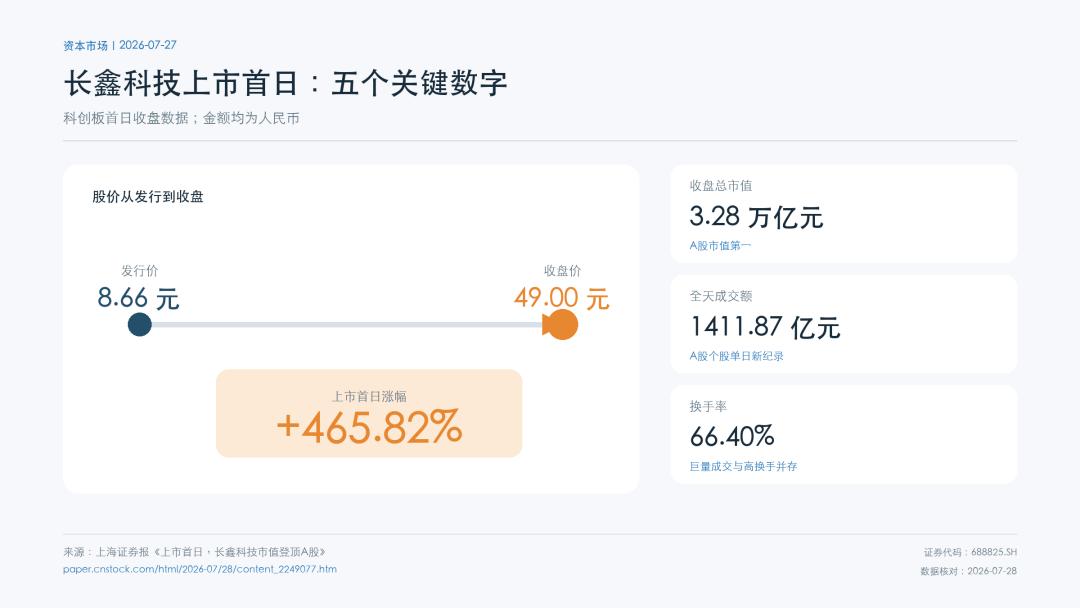
长鑫科技于7月27日在上海科创板上市,发行价8.66元,收盘价达49元,首日涨幅达465.82%1。上市首日,长鑫科技的总市值约为3.28万亿元,成为当日A股市值第一1。首日成交额约1411.87亿元,刷新了A股个股单日成交纪录1。
根据招股书数据,长鑫科技2026年第一季度营业收入为508.00亿元,净利润达330.12亿元,归属于母公司的净利润为247.62亿元1。然而,截至2025年末,公司累计未弥补亏损仍为366.50亿元1。在产能扩张方面,长鑫科技2025年末的月产能约为30万片,预计2026年末将升至35万至40万片1。根据招股书披露,长鑫科技2025年第四季度在全球DRAM市场的收入份额为7.67%1。
在市场价格方面,2026年第一季度传统DRAM合约价环比上涨93%至98%1,而DDR5现货价格曾大幅上涨627%,从约4.68美元涨至34.08美元1。长鑫科技本次募资总额约579.19亿元,拟投向生产线技术升级75亿元、DRAM技术升级130亿元和前瞻技术研发90亿元1。2025年中国集成电路进口额约4243.33亿美元,同比增长10.1%1。
Changxin Technology made its public market debut on July 27, reaching a closing price of 49 yuan and a market capitalization of approximately 3.28 trillion yuan, becoming the highest-valued stock on the A-shares that day 1. The company's initial public offering price was set at 8.66 yuan, representing a first-day gain of 465.82% 1. Trading volume reached approximately 141.187 billion yuan in single-day turnover for an individual A-share stock 1.
As the world's fourth-largest DRAM manufacturer, Changxin is positioned to impact the memory chip market. The company's financial projections for the first quarter of 2026 show operating revenue of 50.8 billion yuan, net profit of 33.012 billion yuan, and net profit attributable to parent company shareholders of 24.762 billion yuan 1. However, the company carried accumulated losses of 36.65 billion yuan through the end of 2025 1. During the same projection period, traditional DRAM contract prices are expected to rise between 93% and 98% compared to the prior quarter, while DDR5 spot prices have experienced volatility, surging 627% from approximately 4.68 dollars to 34.08 dollars at their peak 1.
Changxin's production capacity stood at approximately 300,000 wafers monthly by the end of 2025, with plans to expand to between 350,000 and 400,000 wafers monthly by year-end 2026 1. As of the fourth quarter of 2025, the company commanded a 7.67% share of global DRAM revenue 1. The company raised approximately 57.919 billion yuan in its initial public offering, allocating 7.5 billion yuan toward production line technology upgrades, 13 billion yuan for DRAM technology advancement, and 9 billion yuan for cutting-edge technology research and development 1.
评论
还没有评论,欢迎留下第一条。