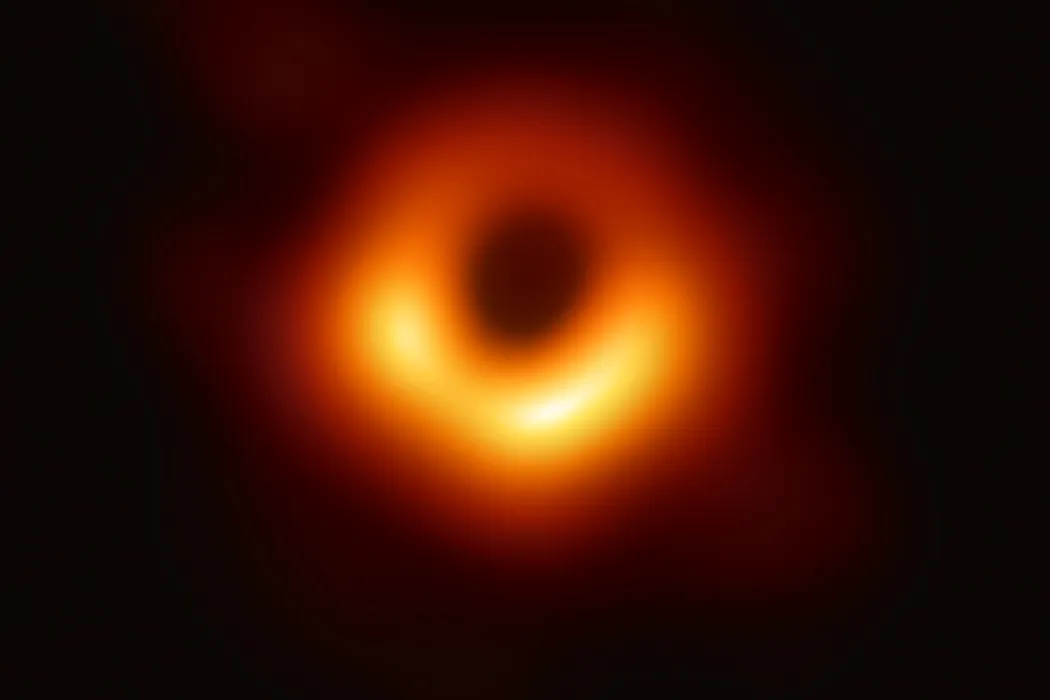
澳大利亚联邦科学与工业研究组织(CSIRO)的研究团队发表了一项新成果,利用机器学习和“闭合不变量”技术,独立验证了2019年事件视界望远镜(EHT)发布的M87星系中心超大质量黑洞图像的准确性 1。这项由Ivy Wong、Nithyanandan Thyagarajan、Samuel Lai和Foivos Diakogiannis组成的团队进行的研究刊登在《Nature》杂志上,确认了黑洞环状结构的准确性,为这一重大科学成果提供了新的视角和信心 1。
该研究的核心在于消除传统数据处理中的误差和偏见 1。团队采用了一种名为“闭合不变量”的新数据组合方法,通过结合三个望远镜的测量值而非成对测量,以消除大气和仪器误差 1。此外,研究人员使用了名为GenDIReCT的机器学习成像方法,该方法在陆地图像(如猫、狗、汽车等)上进行训练,以避免对黑洞外观的先验偏见 1。
最终成像结果证实,观测到的环状结构与65亿倍太阳质量的超级黑洞一致 1。相关数据于2025年12月4日获准查看EHT观测数据后得出,进一步巩固了2019年4月10日EHT合作组织发布的首张距离地球约5500万光年的M87黑洞照片的可信度 1。该技术未来可能应用于医学成像或地震测绘等多传感器数据融合领域 1。
A research team from Australia's Commonwealth Scientific and Industrial Research Organisation (CSIRO) has independently validated the first-ever image of a black hole, originally released by the Event Horizon Telescope (EHT) collaboration in April 2019. 1 The study, published in Nature, confirms that the ring-shaped structure depicted in the original photograph accurately represents the supermassive black hole at the center of galaxy M87, located approximately 55 million light-years from Earth. 1 By employing novel data processing techniques, the researchers addressed potential biases inherent in traditional imaging methods, thereby reinforcing confidence in this major scientific achievement. 1
The CSIRO team, consisting of Ivy Wong, Nithyanandan Thyagarajan, Samuel Lai, and Foivos Diakogiannis, utilized two key innovations to achieve these results. 1 First, they applied a method called "closure invariants," which combines measurements from three telescopes rather than just pairs, effectively eliminating errors caused by atmospheric conditions and instrumental noise. 1 Second, they used a machine learning algorithm named GenDIReCT for image reconstruction. 1 Crucially, this algorithm was trained exclusively on terrestrial images—such as cats, dogs, and cars—to ensure it held no prior assumptions about what a black hole should look like, thus avoiding bias toward expected visual patterns. 1
The independent analysis, which became possible when the team was granted access to the EHT observational data on December 4, 2025, concluded that the reconstructed image is consistent with a supermassive black hole possessing a mass 6.5 billion times that of the Sun. 1 Beyond astrophysics, the authors note that the technology developed in this study could potentially be adapted for other fields requiring multi-sensor data fusion, such as medical imaging or seismic mapping. 1
评论
还没有评论,欢迎留下第一条。