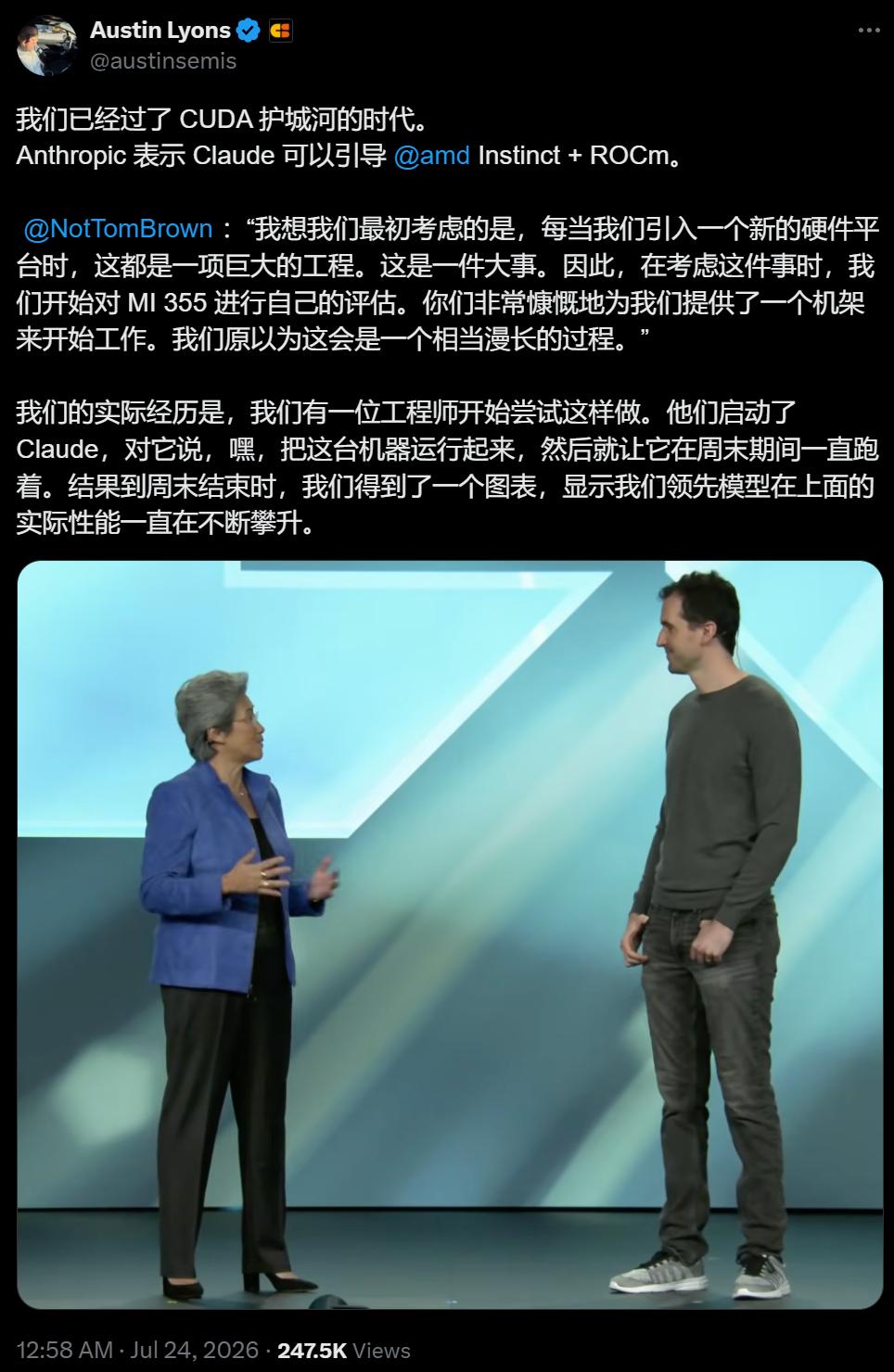
Anthropic的AI助手Claude在一个周末内独立调通了AMD新型GPU MI355X,全程未经工程师手动修改代码1。这一突破背后是AMD新发布的ROCm.AI工具套件,该套件配备AMD Skills和AI可读的ISA指令集,使得AI Agent能够自主读取芯片文档、优化工作负载1。AMD同步将芯片说明书改写为AI可读格式,并对每一代GPU公开指令集1。
Anthropic在实际应用上也展现出对AMD芯片的信心。该公司计划在AMD Helios系统中部署最高2GW的Instinct GPU,首批1GW将于2027年上半年启动1。在Hyperloom的演示中,MiniMax M3的输出速度获得了38%的提升,一次运行中跑过1.4万个模型1。
Anthropic's AI assistant Claude independently debugged and optimized AMD's new MI355X GPU over the course of a single weekend without requiring manual code modifications by engineers 1. The achievement underscores a significant shift in how AI workloads adapt to new hardware architectures, bypassing traditional software optimization bottlenecks that have historically favored established platforms.
AMD's newly released ROCm.AI toolkit enabled this breakthrough by equipping AI agents with the capability to autonomously read chip documentation and optimize workloads 1. The company transformed chip specifications into machine-readable formats and made instruction sets publicly available for each GPU generation, fundamentally altering the competitive dynamics in AI infrastructure 1. This approach has been characterized as a decisive challenge to NVIDIA's two-decade-old CUDA ecosystem dominance 1.
Anthropic has announced plans to deploy up to 2 gigawatts of AMD Instinct GPUs within the AMD Helios system, with the initial 1-gigawatt deployment beginning in the first half of 2027 1. In demonstrations of the Hyperloom system, the MiniMax M3 output speed was improved by 38 percent, and a single run processed 14,000 models 1.
评论
还没有评论,欢迎留下第一条。