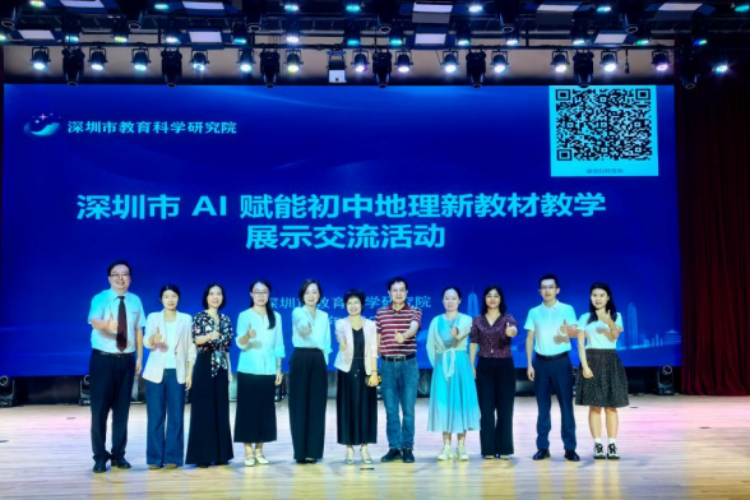
深圳市教育科学研究院近日主办了一场AI赋能初中地理新教材教学展示交流活动,在深圳实验学校初中部举行,深入探讨人工智能技术在地理教学中的实践应用1。龙华区教科院附属外国语学校教师智泽亚讲授了展示课《学看等高线地形图》,展示了如何将AI技术融入具体的地理课堂教学1。
来自南京师范大学的教授朱雪梅在活动中提出,课堂结构正在经历从传统的"师—生"二元结构向"师—生—机"三元复合体的转型1。对此,深圳市教科院初中地理教研员张静指出,推进"地理+AI"融合教学须坚守地理学科本位,锚定核心素养培育目标1。本次活动通过课堂展示和专家报告等多种形式,强调了教师在拥抱新技术的同时需要确保学科教学的严谨性1。
Shenzhen's Municipal Institute of Educational Science recently hosted an exchange activity showcasing artificial intelligence applications in junior high geography instruction, demonstrating how emerging technologies can enhance classroom learning while maintaining disciplinary rigor 1. The event, held at the junior high division of Shenzhen Experimental School, featured live demonstration lessons and expert discussions on integrating AI into geography education to cultivate core student competencies 1.
The centerpiece of the gathering was a demonstration lesson titled "Learning to Read Contour Maps," taught by Zhi Zeya from the Foreign Language School Affiliated to Longhua District Institute of Education and Science 1. This session illustrated practical methods for embedding AI tools into geography instruction. Nanjing Normal University Professor Zhu Xuemei presented her perspective that classrooms are undergoing structural transformation from a traditional "teacher-student" binary model to a "teacher-student-machine" tripartite system 1. Echoing this pedagogical shift, Zhang Jing, the Municipal Institute's junior high geography specialist, emphasized that while pursuing "geography plus AI" integration, educators must maintain subject-specific foundations and remain focused on developing students' core geographic literacy 1.
评论
还没有评论,欢迎留下第一条。