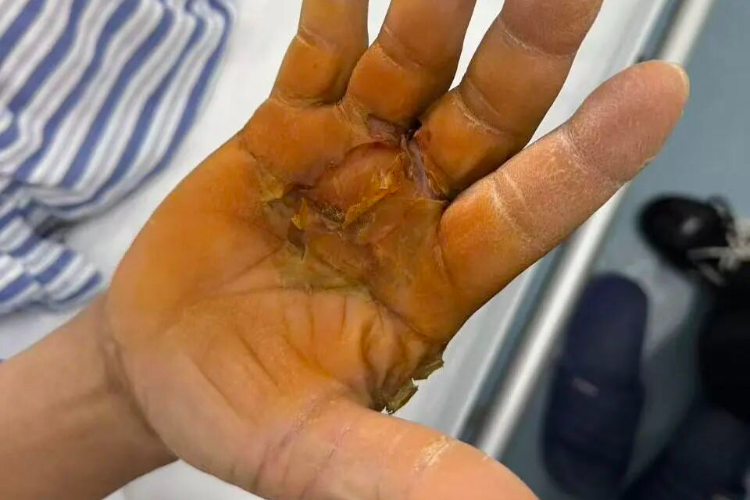
深圳水产从业者老杨在今年9月处理海鱼时被鱼背刺刺伤右手掌心,由于未及时消毒,伤口感染了海洋创伤弧菌并发展为脓毒血症1。血培养结果确认致病菌为海洋创伤弧菌1。患者随即出现手掌肿胀溃烂、高烧不退等严重症状1。
老杨初期在医院接受了7天治疗后出院,但在随后两三天内伤口复发溃烂1。经转诊至深圳市第三人民医院,核磁共振检查发现其右手前臂深处存在约两厘米的脓包1。经过精准救治,患者最终得以康复出院1。
医学专家指出,海洋创伤弧菌病具有极高的致命性1。该菌病死率可达50%-70%,其中超过半数患者在感染后48小时内病情恶化,若72小时内未接受有效治疗,病死率接近100%1。感染主要途径包括皮肤破损接触带菌海水和海鲜,以及生食牡蛎、贝类等海产品导致的消化道感染1。年老体弱、免疫力低下和肝病患者属于高危人群1。医生提醒市民警惕海鲜刺伤暗藏的致命风险1。
A seafood industry worker in Shenzhen nearly lost his life after being punctured by a fish spine while processing sea fish in September 2024.1 The man, identified as Yang, sustained a wound to his right palm that he failed to disinfect promptly, resulting in infection with Vibrio vulnificus, a marine bacterium commonly called a "flesh-eating" pathogen.1 Blood cultures confirmed the causative agent as Vibrio vulnificus, which progressed into septicemia.1 Initial symptoms included severe swelling and tissue breakdown of the palm accompanied by persistent high fever.1
After seven days of treatment at a preliminary hospital, Yang was discharged but experienced wound deterioration within two to three days, necessitating transfer to Shenzhen Third People's Hospital.1 Magnetic resonance imaging revealed an approximately two-centimeter abscess deep within his right forearm.1 With specialized intervention, he eventually recovered and was discharged.1
Vibrio vulnificus infection carries an extremely high mortality rate of 50 to 70 percent, with over half of infected patients deteriorating within 48 hours of infection.1 Without effective treatment within 72 hours, the mortality rate approaches 100 percent.1 The bacterium primarily spreads through two routes: direct contact between skin wounds and contaminated seawater or raw seafood, and ingestion of raw or undercooked shellfish such as oysters and clams.1 Elderly individuals, those with compromised immune systems, and patients with liver disease face elevated risk.1
评论
还没有评论,欢迎留下第一条。