墨尔本大学研究团队发表了一项跨越45年的大规模研究,分析了英文中关于精神健康、残障和神经多样性群体用语的演变趋势。1该研究涵盖15种相关条件,利用Google Books数据库(1980-2019年)和全球新闻数据库(2010-2025年)的数据进行了深入分析。1
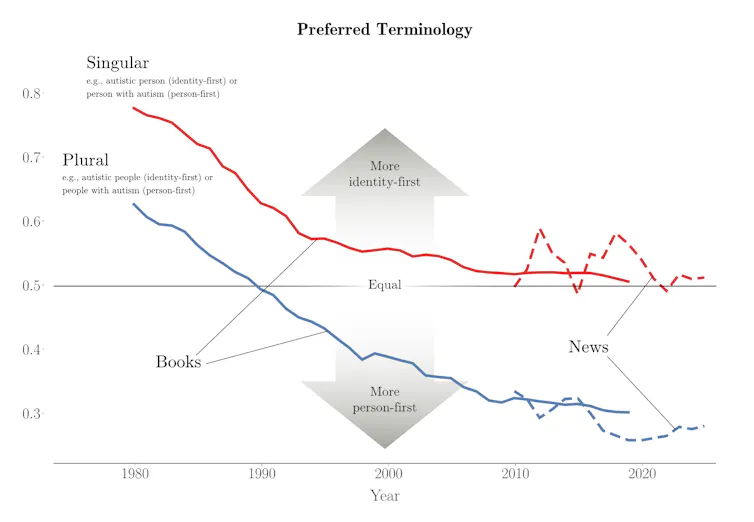
研究发现,身份优先语言(如"自闭症患者")在1980年代曾占主导地位,但之后逐步下降,并从2010年起基本趋于稳定。1不过,美国心理协会在2020年表示支持采用身份优先的表达方式。1更值得注意的是,用语偏好因语境和条件而异:在描述个体时,身份优先表达更为常见,而在描述群体时,人优先表达(如"患有自闭症的人")的使用频率更高。1
不同的残障或精神健康条件也展现出明显的用语差异。1自闭症和阅读障碍倾向于采用身份优先语言,而躁郁症、厌食症和肥胖症则更多使用人优先表达。1
A large-scale longitudinal study spanning 45 years has revealed how terminology for autism, mental health conditions, and disabilities has evolved in English-language publications.1 Researchers from the University of Melbourne analyzed trends using Google Books data from 1980 to 2019 and global news databases from 2010 to 2025, examining language patterns across 15 different conditions.1
The research found that identity-first language—such as "autistic person"—dominated during the 1980s but experienced steady decline over subsequent decades.1 However, this shift plateaued after 2010, with no significant changes observed in subsequent years.1 The American Psychological Association endorsed identity-first language in 2020.1 Notably, language preferences vary substantially depending on context and condition: when describing individuals, identity-first expressions are more common, while person-first language—such as "person with autism"—appears more frequently in group-level discussions.1 Different conditions also show distinct terminological patterns, with autism and dyslexia trending toward identity-first usage, whereas bipolar disorder, anorexia, and obesity favor person-first phrasing.1
评论
还没有评论,欢迎留下第一条。