健美运动在过去一个多世纪的演变中,已经大幅偏离了古典艺术所代表的人体理想。119世纪健美运动的奠基人尤金·桑多生于1867年的普鲁士,他最初追求的是古希腊的身体比例与对称。11901年,桑多在伦敦皇家艾伯特音乐厅举办了世界首次主要健美比赛,评审标准聚焦于整体发展、对称性、比例和肤色,而非单纯的体型大小。1这一审美标准的灵感来自5世纪古希腊雕刻家波利克莱图斯创作的《持矛者》,该作品强调身体各部分的数学关系。1
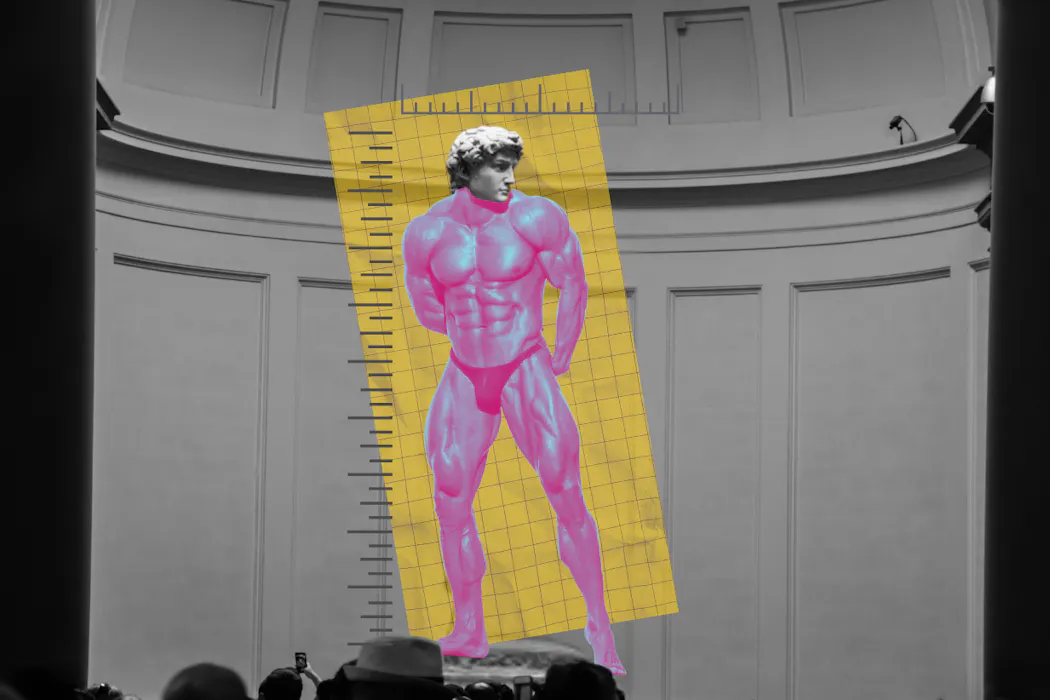
然而,自20世纪中期以来,药物的出现彻底改变了健美竞技的走向。1合成睾酮在1930年代问世,而类固醇则在1950年代开始被广泛使用。1到了1970年代的黄金时代之后,健美运动逐渐演变为1990年代的"肌肉怪物"体型,这一转变由人类生长激素和胰岛素等肽类药物驱动。1对比之下,米开朗基罗的雕塑作品《大卫》呈现的是精瘦、长肢的运动员风格,与当代职业健美选手的体格相去甚远。1为了回应这些变化,现代健美运动最终创立了"古典健美"部门。1
The modern competitive bodybuilding ideal has strayed far from the classical proportions celebrated in ancient Greek sculpture and Renaissance art. Michelangelo's David presents a lean, long-limbed athletic form that bears little resemblance to the "mass monster" physiques dominant in professional bodybuilding today 1. This transformation reflects a century-long evolution driven by pharmaceutical enhancement and changing aesthetic priorities within the sport.
The shift began with Eugene Sandow, a fitness pioneer born in Prussia in 1867, who sought to revive ancient Greek ideals of bodily proportion and symmetry 1. Sandow organized the world's first major bodybuilding competition in 1901 at London's Royal Albert Hall, where judges evaluated competitors on overall development, symmetry, proportion, and skin tone—notably excluding sheer muscle size as a criterion 1. His vision was grounded in the mathematical relationships of bodily proportion that sculptor Polyclitus had emphasized in his fifth-century work, the Doryphoros, or Spear-Bearer 1.
However, the advent of synthetic testosterone in the 1930s and widespread steroid use in the 1950s fundamentally altered bodybuilding's trajectory 1. By the 1970s, the sport's "Golden Age" had already begun transitioning toward the exaggerated muscularity of the 1990s, fueled by peptide hormones such as human growth hormone and insulin 1. This divergence from classical aesthetics eventually prompted the sport to establish a "classical bodybuilding" division in response to these changes 1.
评论
还没有评论,欢迎留下第一条。