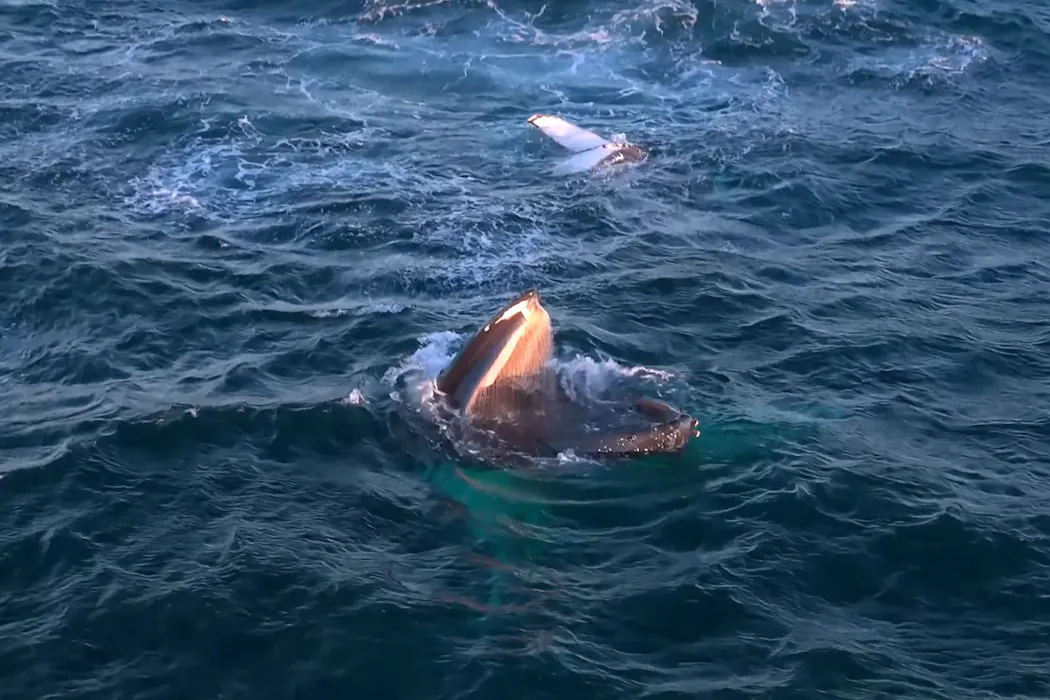
一项发表于《Marine Mammal Science》期刊的最新研究指出,座头鲸在沿澳大利亚东海岸迁徙的过程中会中途进食 1。该研究通过分析Facebook和Instagram等社交媒体平台以及公民科学收集的数据,挑战了此前认为座头鲸仅靠南极夏季储存脂肪完成迁徙和繁殖的“盛宴或饥荒”理论 1。
在2013年至2024年期间,研究记录了199次独立进食观察,涉及约1417头座头鲸 1。数据显示,进食观察在每年8月至10月间增加,期间有16次观察到20至超过150头鲸鱼组成的“超级群体”在同一区域进食 1。从地理分布来看,新南威尔士州南海岸(Eden、Merimbula、Bermagui附近)占所有已验证进食事件的45% 1。塔斯马尼亚东部和南部占28%,维多利亚州海岸占12% 1。
研究指出,这些进食热点与人类活动重叠,呼吁调整保护管理策略 1。此外,Olaf Meynecke获得了私人慈善信托基金对Whales & Climate Research Program的资助 1。Sarah Mcculloch是致力于海洋哺乳动物保护与研究的非政府组织Humpbacks & High-rises的主席 1。
A new study published in the journal Marine Mammal Science has revealed that humpback whales stop to feed during their migration along the eastern coast of Australia 1. Utilizing data from social media platforms such as Facebook and Instagram, alongside citizen science, researchers discovered that these whales do not rely solely on fat stored during the Antarctic summer to complete their migration and breeding, challenging the previous "feast or famine" theory 1. The research documented 199 independent feeding observations involving approximately 1,417 humpback whales between 2013 and 2024 1.
Feeding observations were found to increase annually between August and October 1. The southern coast of New South Wales, particularly near Eden, Merimbula, and Bermagui, emerged as the primary hotspot, accounting for 45% of all verified feeding events 1. Eastern and southern Tasmania accounted for 28% of the observations, while the coast of Victoria made up 12% 1. Notably, researchers recorded 16 instances of "super groups" consisting of 20 to over 150 whales feeding in the same area 1.
The study highlights that these feeding hotspots overlap with human activities, prompting calls for adjustments in conservation management strategies 1. The research context involves Olaf Meynecke, who received funding from a private charitable trust for the Whales & Climate Research Program, and Sarah Mcculloch, chair of Humpbacks & High-rises, a non-governmental organization dedicated to marine mammal conservation and research 1.
评论
还没有评论,欢迎留下第一条。