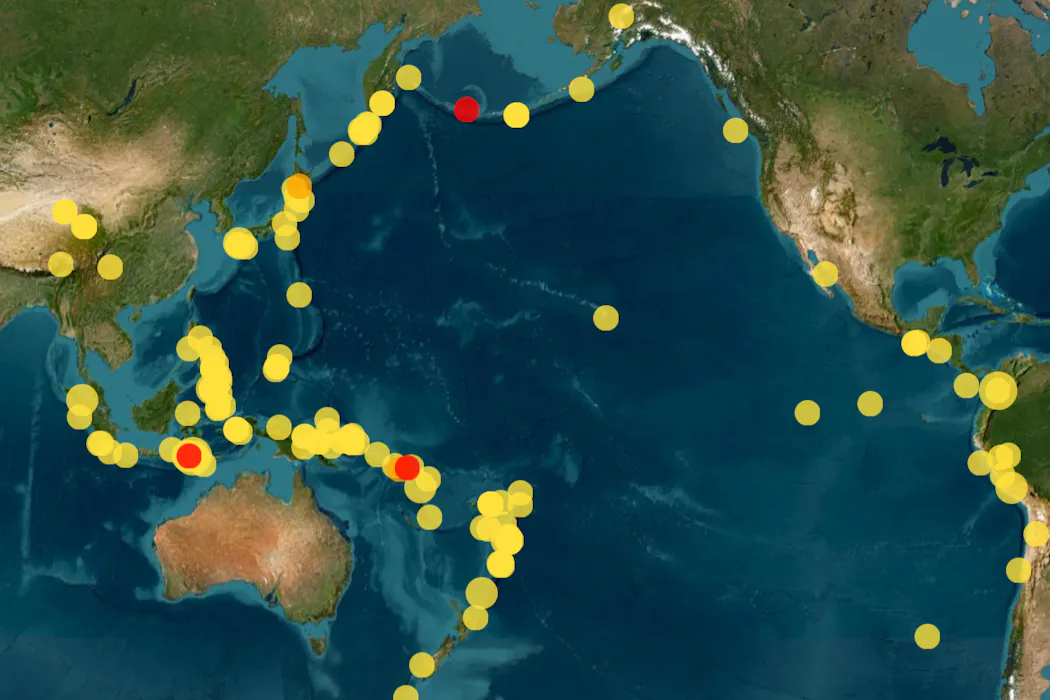
针对近期全球多地发生破坏性地震后公众的关切,科学家通过分析全球地震数据,回应了地震是否变得更加频繁的问题 1。过去三个月,全球多地发生大地震,包括菲律宾7.8级、印尼7.7级、委内瑞拉7.5级和7.2级、哥伦比亚7.4级以及日本6.8级地震 1。此外,夏威夷岛发生6.0级地震,西班牙格拉纳达发生5.2级地震 1。
数据显示,全球平均约每8天发生一次6.5级及以上地震,每年约46次 1。截至2026年8月21日,2026年已发生26次6.5级及以上地震 1。2026年6.5级及以上地震数量略低于平均水平,也略低于过去40年的年均频率 1。近期地震数量并不异常,但因靠近人口中心并造成破坏而受到广泛关注 1。近期地震频发感可能源于近因偏差和频率错觉(即巴德尔-迈因霍夫现象) 1。
Scientists analyzed global seismic data on August 21, 2026, to address public concerns over whether earthquakes are occurring more frequently 1. Over the past three months, several destructive major earthquakes have struck various parts of the world, including a magnitude 7.8 in the Philippines, a 7.7 in Indonesia, a 7.5 and a 7.2 in Venezuela, a 7.4 in Colombia, and a 6.8 in Japan 1. Additionally, a magnitude 6.0 earthquake hit Hawaii Island, while a magnitude 5.2 tremor occurred in Granada, Spain 1.
Despite the widespread attention caused by these recent events, the data indicates that the frequency of earthquakes is not abnormal 1. Globally, an average of about 46 earthquakes of magnitude 6.5 or higher occur each year, which translates to roughly one every eight days 1. As of August 21, 2026, there have been 26 earthquakes of magnitude 6.5 or above this year, a figure that is slightly below the average level and also marginally lower than the annual frequency observed over the past 40 years 1.
Scientists point out that these recent quakes have drawn significant attention primarily because they occurred near population centers and caused substantial damage 1. The public perception that earthquakes are happening more often is likely driven by cognitive biases, specifically recency bias and the Baader–Meinhof phenomenon, also known as the frequency illusion 1.
评论
还没有评论,欢迎留下第一条。