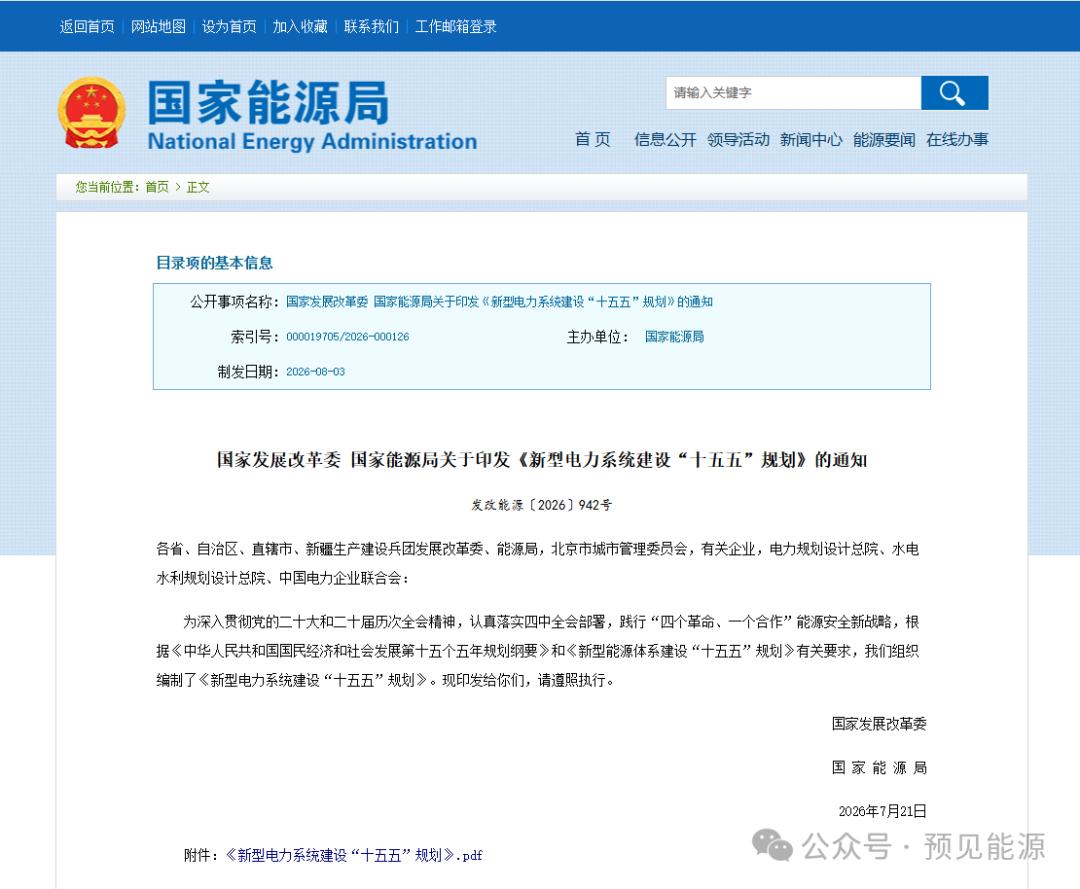
国家发改委、国家能源局8月3日印发《新型电力系统建设"十五五"规划》[1]。根据规划,国家电网"十五五"期间固定资产投资预计达到4万亿元,较"十四五"投资增长40%[1];南方电网"十五五"总投资将达1万亿元左右[1]。两大电网合计投资近5万亿元,较"十四五"同期增长超80%[1]。
规划落地与大规模招标同步推进。在2026年特高压设备前三批次招标中,中国西电下属14家子公司合计中标41.29亿元,平高电气中标约18.18亿元,许继电气中标约12.45亿元[1]。2026年特高压设备前三批次累计中标金额达292.61亿元,超过2025年全年220.62亿元[1]。
规划还明确了新型储能和虚拟电厂等关键领域的发展目标。到2030年,新型储能装机规模将达到3亿千瓦,较2025年1.36亿千瓦增长约1.6亿千瓦[1];虚拟电厂最大调节能力将超过5000万千瓦,较2025年1685万千瓦翻倍增长[1]。
China's National Development and Reform Commission and National Energy Administration released the "15th Five-Year Plan for New Power System Construction" on August 3, establishing a substantial investment blueprint for the nation's power infrastructure [1]. The plan allocates approximately 4 trillion yuan for State Grid Corporation and around 1 trillion yuan for China Southern Power Grid, bringing combined investment to nearly 5 trillion yuan over the period [1]. This represents a significant acceleration compared to the 14th Five-Year Plan, with total national grid fixed asset investment projected to exceed 5 trillion yuan, marking an increase of over 80% from the corresponding period of the previous plan [1].
The policy announcement has triggered immediate commercial activity among power equipment manufacturers. In the first three batches of ultra-high-voltage equipment procurement for 2026, major enterprises including China XD Electric, Pinggao Electric, and Xu Ji Electric collectively secured contracts worth 71.92 billion yuan [1]. Specifically, China XD Electric's 14 subsidiaries won orders totaling 41.29 billion yuan, Pinggao Electric secured approximately 18.18 billion yuan, and Xu Ji Electric obtained roughly 12.45 billion yuan [1]. The cumulative tender amount of 292.61 billion yuan across these three procurement batches has already surpassed the full-year 2025 figure of 220.62 billion yuan [1].
Beyond generation infrastructure, the plan sets ambitious targets for energy storage and grid flexibility. New energy storage capacity is projected to reach 300 million kilowatts by 2030, growing from 136 million kilowatts in 2025, an increase of approximately 164 million kilowatts [1]. Virtual power plant maximum adjustment capacity is expected to exceed 50 million kilowatts by 2030, more than doubling from the 16.85 million kilowatts in 2025 [1].