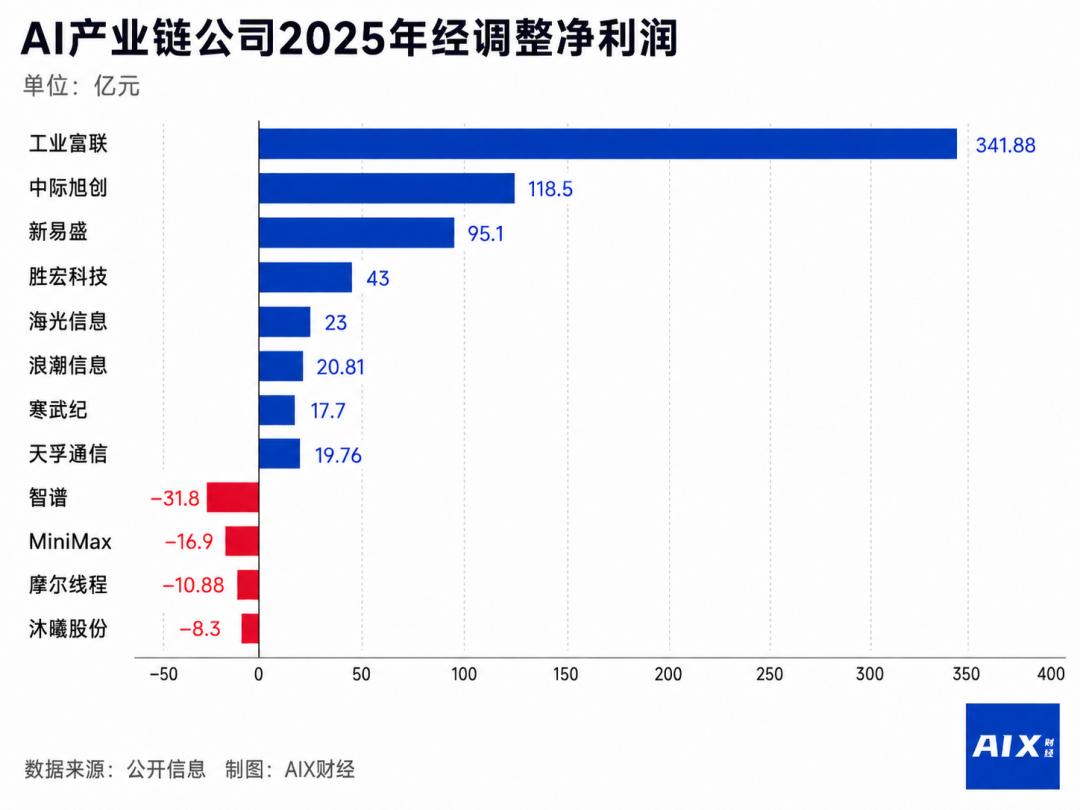
尽管大模型企业普遍陷入亏损,但中国AI产业链的利润正沿着资本开支的传导路径流向上游硬件供应商。2025年至2026年初,光模块龙头中际旭创和新易盛表现突出,中际旭创2025年归母净利润达118.5亿元,同比增长112%,2026年一季度单季利润57.2亿元,已超过2024年全年水平;新易盛同年收入248亿元,归母净利润95.1亿元,同比增长236%[1]。两家公司的境外收入占比分别达90.58%和96.16%[1]。
与此同时,国产芯片公司也相继实现盈利。寒武纪2025年营收64.97亿元,同比增长453.21%,首次实现全年盈利17.7亿元;海光信息2026年一季度营收40.34亿元,同比增长68.06%[1]。
云厂商和服务器厂商则从规模和流水中获益。工业富联2025年收入9028.87亿元,同比增长48.22%,但净利率仅约3.79%;浪潮信息同年收入1647.78亿元,收入增长43.25%,利润增速仅11%[1]。相比之下,大模型厂商亏损最为严重,智谱AI 2025年亏损30多亿元,MiniMax亏损17亿元[1]。
这种产业利润格局正面临挑战。从2023年到2025年末,全球AI资本开支已累计超过1万亿美元,而预计2026年至2030年五年间将达到6万亿美元[1]。2026年九大云厂商合计资本支出将达约8300亿美元,同比增长79%,其中光模块市场将获得约380亿美元[1]。尽管光模块在全球应用比重从2021年的约10%增长到2025年的60%[1],但中金公司预测大型云厂商合计自由现金流可能由2025年的约2000亿美元降至2027年的约240亿美元,资本开支增速放缓与供给端竞争加剧可能重塑产业利润分配格局[1]。
Over the past three years, China's AI industry has generated substantial capital expenditures, but the profits have flowed unevenly across the supply chain.[1] While large language model companies face significant losses, upstream hardware suppliers and chip manufacturers have emerged as the primary beneficiaries, capturing the most substantial gains from the sector's expansion.
The contrast in financial performance is striking. In 2025, Zhipu AI reported losses exceeding 3 billion yuan, while MiniMax lost 1.7 billion yuan.[1] Yet their losses stand in sharp relief against the surging profits upstream. Zhongji Xuechuang, a leading optical module supplier, achieved net profit of 11.85 billion yuan in 2025, up 112 percent year-over-year, with a single quarter in early 2026 generating 5.72 billion yuan—exceeding its entire 2024 annual profit.[1] Xinyisheng similarly posted revenue of 24.8 billion yuan in 2025 with net profit of 9.51 billion yuan, representing a 236 percent increase.[1] Both companies derive the vast majority of their revenue from overseas markets, with Zhongji Xuechuang's overseas revenue accounting for 90.58 percent and Xinyisheng's for 96.16 percent of total sales.[1]
Chinese semiconductor firms have also begun capturing value. Cambricon achieved revenue of 6.497 billion yuan in 2025 with a 453 percent increase year-over-year, posting its first full-year profit of 1.77 billion yuan.[1] Moore Threads narrowed its net loss to 1.088 billion yuan in 2025, a 33 percent improvement, while Muxi reduced losses by 20 percent to 830 million yuan.[1] By contrast, server and cloud infrastructure providers generate scale and revenue volume rather than proportional profits. Industrial Fujilink reported revenue of 902.887 billion yuan in 2025 with a net margin of just 3.79 percent, while Inspur Information achieved 164.778 billion yuan in revenue but saw profits grow only 11 percent despite a 43 percent revenue increase.[1] Alibaba Cloud's model-as-a-service platform is projected to reach annual recurring revenue exceeding 10 billion yuan in the second quarter, climbing to 30 billion yuan by year-end.[1]
The underlying driver of these earnings remains massive capital expenditure. Global AI capital spending exceeded 1 trillion dollars cumulatively from 2023 through end-2025, with projections of 6 trillion dollars over the five-year period from 2026 to 2030.[1] By 2026, nine major cloud providers combined will deploy approximately 830 billion dollars in capital expenditure, a 79 percent year-over-year increase, with optical modules expected to capture roughly 38 billion dollars of that total.[1] This dependency on accelerating capex, however, presents structural vulnerabilities. China International Capital predicted that major cloud providers' combined free cash flow could decline from approximately 200 billion dollars in 2025 to as little as 24 billion dollars by 2027, potentially constraining the sustained reinvestment that has fueled upstream suppliers' profits.[1]