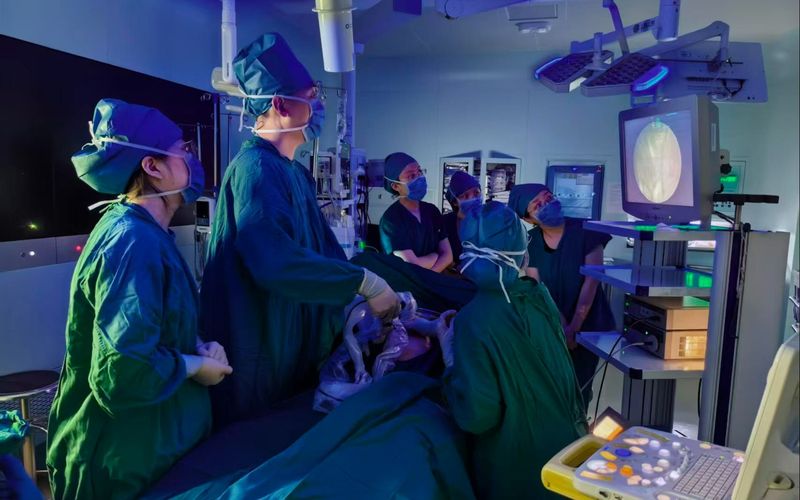
北京妇产医院母胎医学团队正在开展宫内治疗,通过胎儿镜下胎盘血管交通支激光凝固术等手术方式,在胎儿出生前纠正或改善异常,为原本可能被引产的患病胎儿提供生存机会1。近20年来,宫内治疗在国内部分医疗机构推广,随着医学技术进步和患者观念改变,这一治疗方式正逐步被接受1。
双胎输血综合征是宫内治疗的主要适应症。若不采取治疗措施,该病症的围产儿死亡率可高达80%-100%1。宫内治疗是临床上治疗妊娠16-26周II~IV期双胎输血综合征的首选方法1。国内首台胎儿镜下胎盘血管交通支激光凝固术治疗双胎输血综合征于2006年进行1。
目前,北京、广州、上海、重庆等城市部分医疗机构开展了宫内治疗1。中央专项彩票公益金支持提供特定病种胎儿宫内治疗费用补助1。
Beijing Obstetrics and Gynecology Hospital's maternal-fetal medicine team has pioneered in-utero therapeutic interventions, utilizing techniques such as fetoscopic laser ablation of placental vascular anastomoses to correct or improve fetal abnormalities before birth.1 These surgical approaches have given survival opportunities to patients who might otherwise face termination of pregnancy.1 Over the past two decades, in-utero treatment has gradually been adopted by select medical institutions across China, and with advances in medical technology and changing patient attitudes, this therapeutic approach is increasingly gaining acceptance.1
Twin-to-twin transfusion syndrome represents a critical application of these interventions.1 Without treatment, the perinatal mortality rate for this condition can reach 80 to 100 percent.1 For pregnancies between 16 and 26 weeks with stage II to IV twin-to-twin transfusion syndrome, in-utero treatment is the clinical standard of care.1 China's first fetoscopic laser ablation procedure for this condition was performed in 2006.1
To expand access to these life-saving treatments, central lottery public welfare funds have been allocated to subsidize in-utero fetal therapy costs for specific disease categories.1 Medical institutions in Beijing, Guangzhou, Shanghai, and Chongqing have begun offering in-utero treatment services, reflecting the growing availability of this specialized care across major medical centers in China.1
评论
还没有评论,欢迎留下第一条。