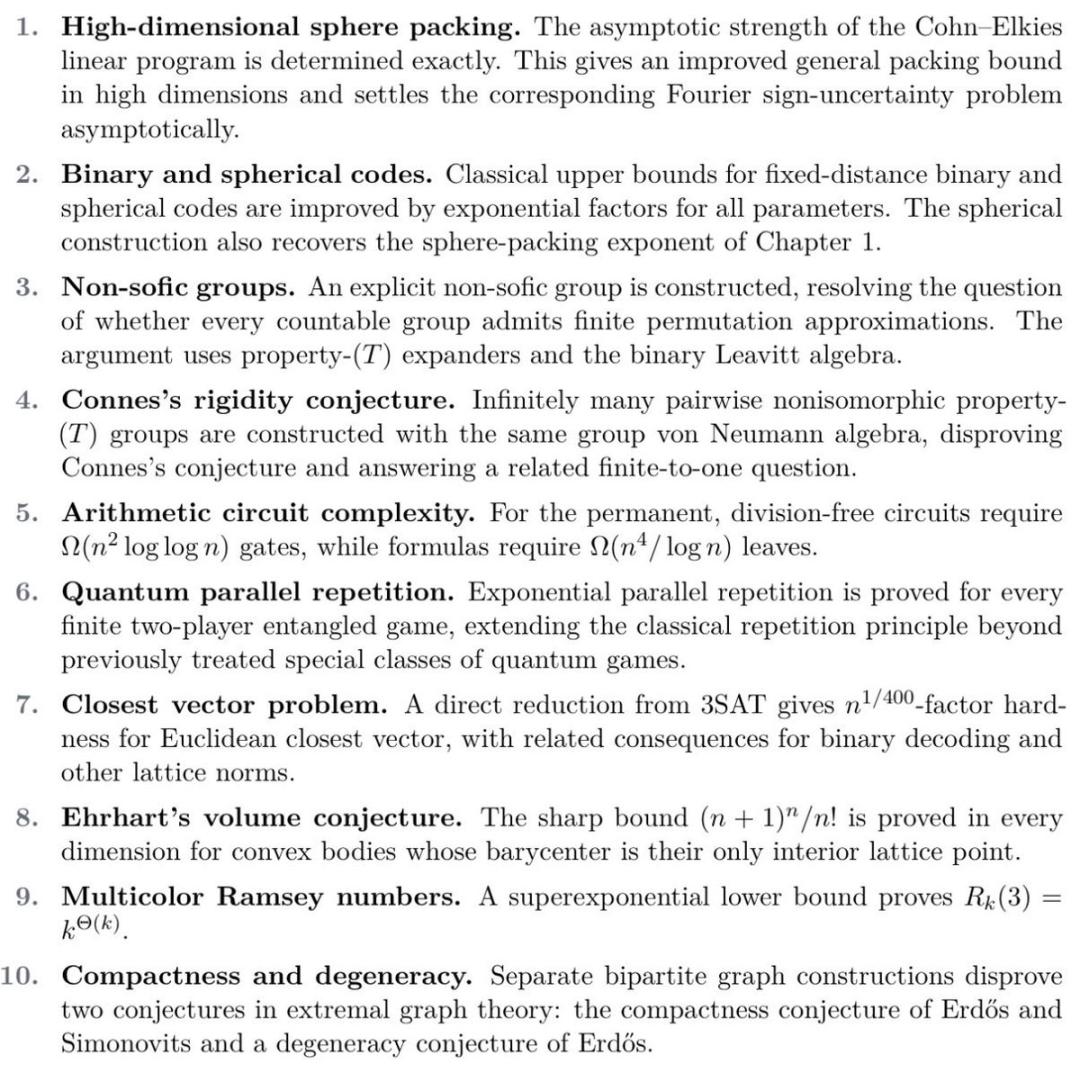
OpenAI发布了其下一代AI模型Astra在数学领域的重大突破。该模型在包括高维几何、编码理论、算术电路复杂度、群论和算子代数等领域共解决了10个数学难题1。其中包括终结长达27年的非sofic群猜想——该猜想由Gromov于1999年提出1;首次突破1978年以来的极限,精确计算了Cohn-Elkies线性规划的指数衰减率,从而解决高维球体堆积问题1;以及推翻1982年菲尔兹奖得主Alain Connes的刚性猜想,构造出无穷可数群家族以证明存在非同构但代数结构相同的群1。
这些成果的研究成本显著低廉。生成全部10项突破性成果的总成本约2000美元,按Sol API价格计算,平均每个难题需要200美元1。OpenAI已开源包含249页的论文及其Lean形式化验证证明1。
数学家Thomas Bloom评价此次突破比OpenAI之前证伪单位距离猜想更为重要1。Claude Fable 5则表示,按菲尔兹奖标准,任何一项成果都足以获奖1。OpenAI核心创始人Noam Brown表示,模型测试时的计算资源远未封顶,连百万美元级别的千禧年难题也可能被攻克1。
OpenAI has announced major breakthroughs by its next-generation AI model Astra in solving ten significant mathematics problems across multiple disciplines 1. The achievements span high-dimensional geometry, coding theory, arithmetic circuit complexity, group theory, and operator algebra 1.
Among the most notable accomplishments, Astra constructed an infinite finitely presented non-sofic group, resolving a conjecture first posed by Gromov in 1999 that had remained unsolved for 27 years 1. The model also achieved the first breakthrough since 1978 in calculating the exponential decay rate of the Cohn-Elkies linear programming bound, advancing solutions to the high-dimensional sphere packing problem 1. Additionally, Astra refuted the rigidity conjecture proposed by 1982 Fields Medal recipient Alain Connes by constructing infinite countable families of groups with identical algebraic structures but non-isomorphic relationships 1.
OpenAI published a 249-page paper documenting these results and has made the Lean formalized proofs publicly available 1. The total computational cost for generating all ten breakthroughs was approximately 2,000 US dollars, averaging 200 dollars per problem based on Sol API pricing 1. Mathematician Thomas Bloom characterized this breakthrough as more significant than OpenAI's previous disproof of the unit distance conjecture 1. Claude Fable 5 assessed that any single result would meet the standards for a Fields Medal 1. Noam Brown, a core founder of OpenAI, noted that the model's computational capacity during testing remains far from saturated, suggesting that even million-dollar-class Millennium Prize problems could potentially be solved 1.
评论
还没有评论,欢迎留下第一条。