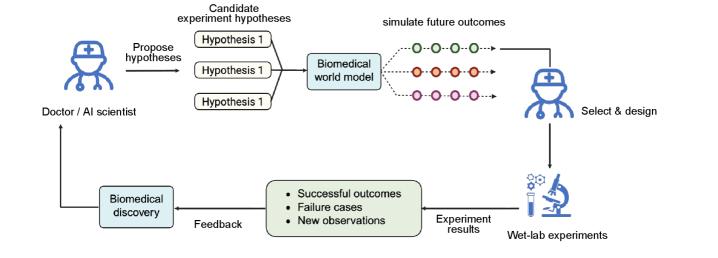
人工智能正在深入生命科学领域。DeepMind首席执行官德米斯·哈萨比斯表示,AlphaFold是AI用于科学研究的"第一个例子",未来方向是利用世界模型真正模拟生命1。通过模拟人体动态过程,这类技术有望应用于精准医疗、疾病预测、药物研发等领域1。
多个机构正在推进相关技术的开发。Meta旗下的Biohub于2026年5月发布了蛋白质结构预测模型ESMFold2及数据库ESM Atlas,包含11亿个预测的蛋白质结构和68亿个蛋白质序列1。美国AI医疗公司NOETIK开发了世界模型OCTO(肿瘤反事实治疗预言机),已获取数千名患者肿瘤样本数据1。中国团队百曜科技研发的CellOS将JEPA引入虚拟细胞研究1,英灵殿则研发了全模态分子世界模型AlloDesign,将蛋白质、DNA、RNA、小分子等纳入统一生成框架1。
尽管前景广阔,该技术仍处于早期阶段,需要更严格的验证和监管1。
Artificial intelligence research institutions are increasingly applying world models to life sciences, seeking to simulate biological processes and advance precision medicine. DeepMind CEO Demis Hassabis characterized AlphaFold as "the first example" of AI contributing to scientific research, emphasizing that the future direction lies in using world models to truly simulate life.1 Such technology is expected to enable applications in personalized medical treatment, disease forecasting, and pharmaceutical development.1
Several organizations are actively developing these capabilities. Meta's Biohub released the protein structure prediction model ESMFold2 and the ESM Atlas database in May 2026, containing 11 billion predicted protein structures and 6.8 billion protein sequences.1 In the United States, the AI medical company NOETIK developed a world model called OCTO (Oncology Counterfactual Treatment Oracle) and has acquired tumor sample data from thousands of patients.1 Chinese researchers at Baiyao Technology introduced JEPA into virtual cell research through their platform CellOS.1 Meanwhile, Lingtang developed AlloDesign, a multimodal molecular world model that integrates proteins, DNA, RNA, and small molecules into a unified generative framework.1
Despite these advances, the technology remains in its early stages and requires more rigorous validation and regulatory oversight.1
评论
还没有评论,欢迎留下第一条。