7月31日,微软和Meta同日发布财报,两家科技巨头在AI投入回报上的差异引发市场剧烈反应。1微软股价大幅上涨15.51%,刷新美股史上最大单日市值增幅纪录,单日市值增加约4500亿美元。1与之形成鲜明对比,Meta股价下跌7.95%。1
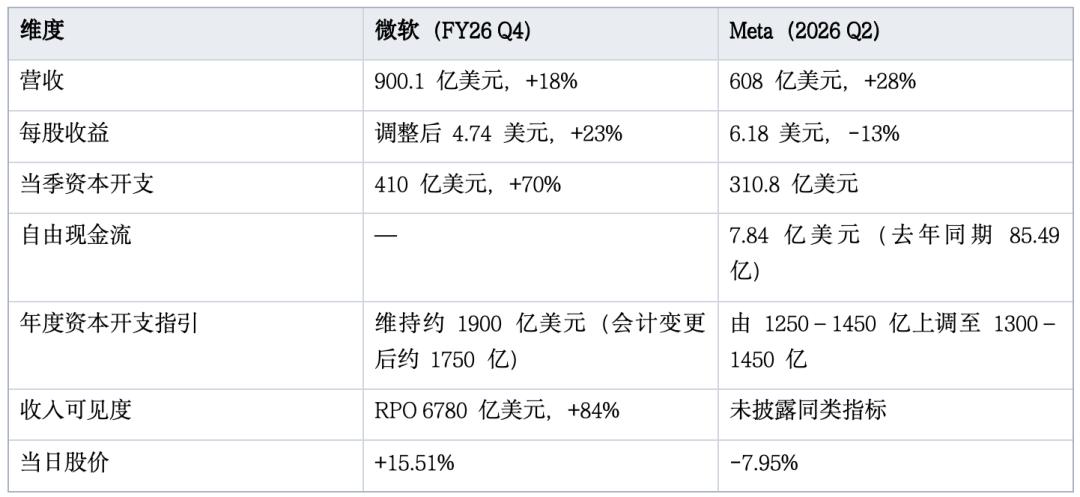
微软的业绩表现展现出AI投入的可观回报。该公司2026财年第四财季营收达900.1亿美元,同比增长18%,调整后每股收益4.74美元,同比增长23%。1Azure及其他云服务收入同比增长43%,全年收入首次突破1000亿美元。1商业剩余履约义务同比增长84%至6780亿美元,约为微软全年营收的两倍。1此外,Microsoft 365 Copilot付费用户已超过3000万。1尽管第四财季资本支出同比增长70%至410亿美元,但微软维持约1900亿美元的年度资本支出计划。1
Meta虽然营收保持增长,但现金流恶化程度更显严重。该公司二季度营收608亿美元,同比增长28%,但每股收益6.18美元,同比下降13%。1最为关键的是,Meta自由现金流仅剩7.84亿美元,同比缩水约91%,创近四年最低。1Meta已将全年资本开支指引调整至1300亿—1450亿美元,下限上调50亿美元。1对此,Meta首席执行官扎克伯格表示"卖掉算力换短期利润是愚蠢的",强调公司不会为短期收益出售算力。1
Microsoft and Meta delivered starkly contrasting financial performances on July 31, despite both companies heavily investing in artificial intelligence infrastructure.1 Microsoft's stock surged 15.51%, marking the largest single-day market capitalization increase in U.S. stock market history, while Meta's shares fell 7.95%.1
Microsoft's fourth fiscal quarter results demonstrated the tangible returns on its AI spending. The company reported revenue of $90.01 billion, up 18% year-over-year, with adjusted earnings per share of $4.74, representing a 23% increase.1 Azure and other cloud services revenue climbed 43% year-over-year, with full-year revenue surpassing $100 billion for the first time.1 Microsoft 365 Copilot now has over 30 million paying users, and commercial remaining performance obligations reached $678 billion—approximately double Microsoft's annual revenue—signaling substantial future revenue streams.1 Capital expenditure in the quarter reached $41 billion, up 70% year-over-year, as Microsoft maintained its $190 billion annual capital spending plan.1 The company's market capitalization grew by approximately $450 billion in a single day, setting a new record for the largest single-day market value increase in U.S. stock history.1
Meta's financial picture presented a contrasting narrative despite respectable top-line growth. The company reported second-quarter revenue of $60.8 billion, up 28% year-over-year, but earnings per share declined 13% to $6.18.1 Most tellingly, Meta's free cash flow plummeted to just $784 million, representing a 91% decline year-over-year and marking the lowest level in nearly four years.1 The company revised its annual capital expenditure guidance upward to between $130 billion and $145 billion, increasing the lower bound by $5 billion.1 CEO Mark Zuckerberg stated that "selling compute for near-term profit is stupid," emphasizing the company's commitment not to sell computing capacity for short-term gains.1
评论
还没有评论,欢迎留下第一条。