亚马逊旗下卫星互联网业务Amazon Leo向美国联邦通信委员会提交申请,计划部署最多5105颗低轨卫星构建卫星直连终端(D2D)通信网络,预计2028年初上线1。为支撑这一业务,亚马逊近期以116亿美元收购Globalstar以获得无线电频谱资源1,并已与苹果达成协议为支持的iPhone和Apple Watch提供卫星服务1。
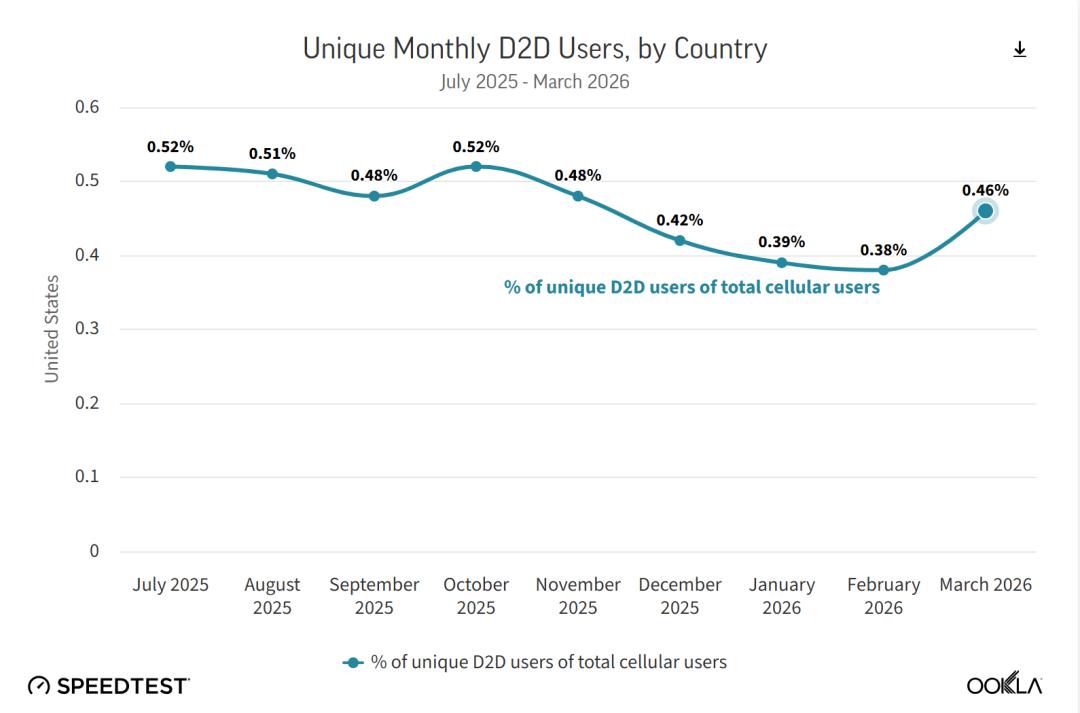
尽管产业布局不断扩大,D2D服务的市场现状仍难令人乐观。根据全球卫星运营商协会二月份报告,D2D服务已在15个国家和地区推出,61个国家正在规划或测试1。然而,市场渗透率极低——2026年3月美国Speedtest用户中仅0.46%连接到D2D卫星,智利最高为1.26%1。此外,由于地面网络已覆盖全球96%人口,D2D连接通常只能室外使用1。T-Mobile和Rogers结束免费试用后,D2D月费约10美元,美国与加拿大近几个月连接数不增反降1。
尽管存在这些挑战,市场预期仍保持乐观。2025年全球D2D卫星连接市场规模为48亿美元,预计2034年达346亿美元,年均增长率为24.5%1。
Amazon's satellite internet division, Amazon Leo, has filed an application with the U.S. Federal Communications Commission to deploy up to 5,105 low-Earth orbit satellites to create a satellite direct-to-device (D2D) communication network, with an expected launch date of early 2028.1 The company recently acquired wireless spectrum resources through its $11.6 billion purchase of Globalstar and has secured an agreement with Apple to provide satellite services to supported iPhones and Apple Watches.1
Despite the ambitious expansion plans, the D2D satellite connectivity market remains in its infancy with significant adoption challenges ahead. According to a February report from the Global System for Mobile Communications Association, D2D services have launched in 15 countries and regions, while 61 nations are planning or testing such technology.1 However, adoption rates remain minimal: only 0.46% of Speedtest users in the United States connected to D2D satellites as of March 2026, with Chile recording the highest penetration at 1.26%.1 Following the conclusion of free trial periods, monthly D2D service fees are approximately $10 in the United States and Canada, where connection numbers have declined rather than increased in recent months.1
The industry faces structural obstacles that may limit D2D's growth trajectory. GSMA Intelligence notes that terrestrial networks already cover 96% of the global population, and D2D connectivity typically functions only outdoors.1 While market analysts project the global D2D satellite connectivity market to reach $48 billion in 2025 and grow to $346 billion by 2034 at a compound annual growth rate of 24.5%, the current low penetration rates and declining user bases following paid service rollouts suggest the technology must overcome substantial technical, cost, and business model challenges to achieve mainstream adoption.1
评论
还没有评论,欢迎留下第一条。