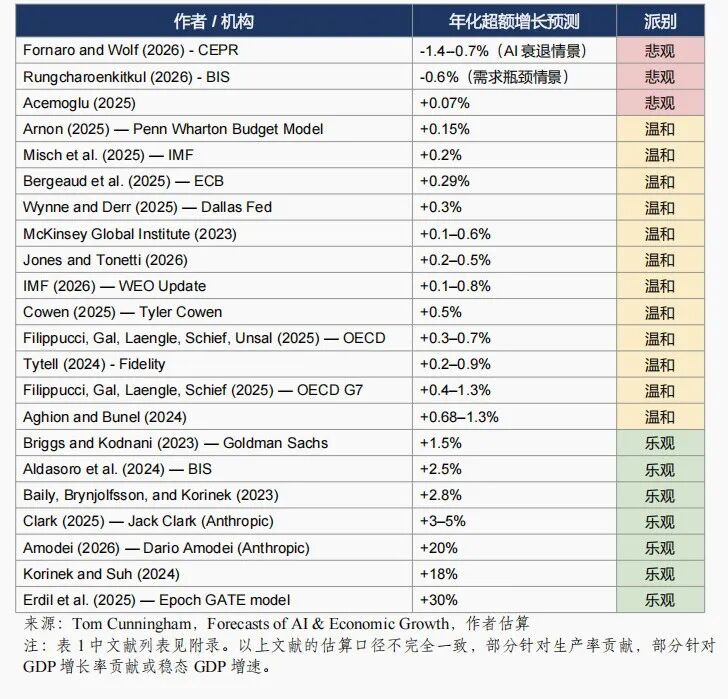
学术界和业界对人工智能的经济影响存在显著分歧。乐观派认为AI可通过递归式自我改进推动爆发式增长,温和派则承认AI会提升生产率但受多种瓶颈制约,悲观派则担忧过度自动化导致失业与需求不足1。高盛测算表明,生成式AI可提升全球生产率1.5个百分点,未来10年将推升全球GDP增长7%1。然而,实际数据呈现出更为复杂的图景:英格兰银行调查显示,近90%高管认为AI对企业过去三年的生产率没有实质影响1,这与乐观预期形成鲜明对比。
在投资端,美国云服务商的资本支出呈现快速增长。预计2026年美国五大云服务商资本开支将突破7500亿美元,接近2022年的5倍;到2030年累计总额将突破5万亿美元1。相比之下,OpenAI和Anthropic合计估值约1.8万亿美元,而2026年最新年化营收分别仅为250亿和470亿美元1,反映出估值与实际收益间的巨大差距。
美国劳动力市场方面,OpenAI估计约19%美国劳动者有超过一半工作任务被AI影响;若考虑配套软件发展,比例升至约46%1。短期内,2025年美国AI相关投资对GDP贡献升至0.8个百分点,较2023年增加了0.7个百分点1。2023年一季度以来,美国非农劳动生产率年化增速为2.7%,明显高于2007-2022年间约1.5%1。
分析认为,短期AI增长主要源于投资拉动而非生产率红利。中期内可能面临多条发展路径,其中温和路径概率最大,但三条路径都存在经济或社会风险,需政策主动干预1。
Generalist artificial intelligence is expected to significantly reshape economic productivity and growth, though experts remain divided on the magnitude and timeline of these effects. Goldman Sachs has estimated that generative AI could lift global productivity by 1.5 percentage points and boost global GDP growth by 7 percent over the next decade 1. The investment surge fueling AI development is substantial: U.S. cloud service providers are projected to spend over $750 billion in capital expenditures by 2026, nearly five times the 2022 level, with cumulative spending expected to exceed $5 trillion by 2030 1. In 2025, AI-related investment is estimated to contribute 0.8 percentage points to U.S. GDP growth, an increase of 0.7 percentage points from 2023 1.
However, the actual productivity gains remain contested. U.S. non-farm labor productivity has grown at an annualized rate of 2.7 percent since the first quarter of 2023, notably higher than the 1.5 percent average between 2007 and 2022 1. Yet a survey by the Bank of England found that nearly 90 percent of executives reported AI has had no substantial impact on their firms' productivity over the past three years 1. Regarding labor displacement, OpenAI estimates that approximately 19 percent of American workers have more than half their job tasks affected by large language models, a figure that could rise to roughly 46 percent when accounting for supporting software development 1. Meanwhile, token usage on the OpenRouter platform has grown over 23 times in the past 18 months, reflecting accelerating AI adoption 1. The economic valuations of leading AI companies appear disconnected from current revenue: OpenAI and Anthropic have a combined valuation of approximately $1.8 trillion but generated only $25 billion and $4.7 billion in annualized revenue respectively 1. Infrastructure constraints are also emerging, as New York State announced in July 2026 a moratorium on environmental permits for new large data centers 1.
评论
还没有评论,欢迎留下第一条。