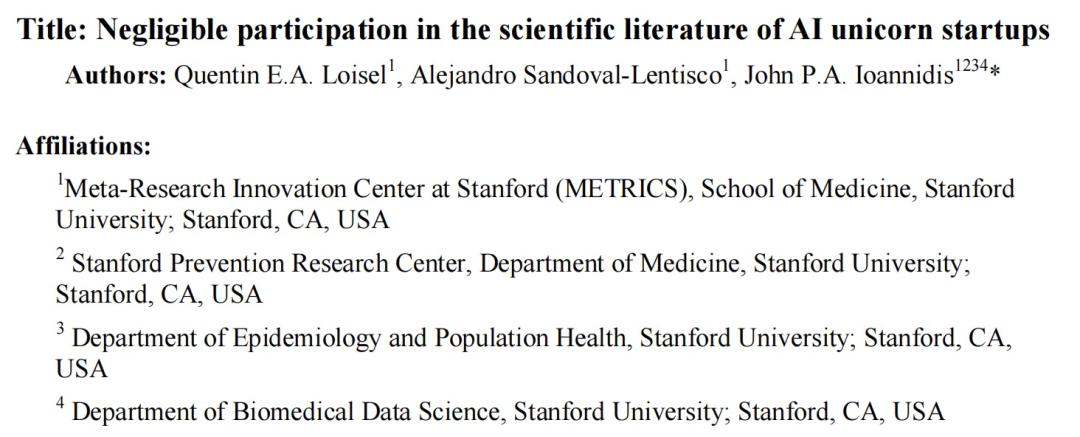
斯坦福大学研究团队对1998年至2025年间的317家AI独角兽公司进行了调查,发现超过半数的此类公司没有公开发表过学术论文1。这项研究表明,尽管AI领域在全球范围内获得巨大关注,但科学成果却高度集中。
研究数据揭示了这一现象的规模。2025年全球AI论文总量超过90万篇,但与这些初创公司相关的论文仅有950篇,占比仅为0.1%1。进一步分析表明,排名前5%的公司贡献了超过90%的引用量,其中OpenAI一家公司就贡献了近40%1。在132篇高被引论文中,仅有27名高产作者就贡献了近四成署名1。
区域差异明显。近三分之二的中国AI独角兽公司曾发表过论文,而美国公司则采取了截然相反的策略,超过半数的美国公司未发表符合条件的论文1。通讯作者John Ioannidis对这一现象表达了疑虑,称"对于一个声称正在重塑科学、并被认为具有巨大科学潜力的领域来说,几乎没有科学文献是一个非常奇怪的悖论"1。
A research team from Stanford University has published findings examining the scientific output of 317 AI unicorn companies, uncovering stark disparities in how these high-valued startups contribute to peer-reviewed literature.1 The study, covering the period from 1998 to 2025, reveals that over half of AI unicorns have produced no publicly available research papers, with scientific contributions heavily concentrated among a small number of firms.1 Across 2025, the global AI research landscape generated over 900,000 papers, yet only 950 papers involved these unicorn startups—representing just 0.1 percent of total output.1
The research demonstrates significant regional differences in publication practices.1 Chinese AI unicorns prove more research-oriented, with nearly two-thirds having published papers, while the majority of their American counterparts have adopted closed-source business models, with over half producing no qualifying publications.1 Citation influence remains extraordinarily concentrated: the top 5 percent of companies account for over 90 percent of all citations, with OpenAI alone contributing nearly 40 percent.1 Among 132 highly-cited papers, just 27 prolific authors generated close to 40 percent of all authorships.1
John Ioannidis, the corresponding author, highlighted the paradox underlying these findings, stating: "For a field claiming to reshape science and widely regarded as possessing enormous scientific potential, having almost no scientific literature is a very strange contradiction."1
评论
还没有评论,欢迎留下第一条。