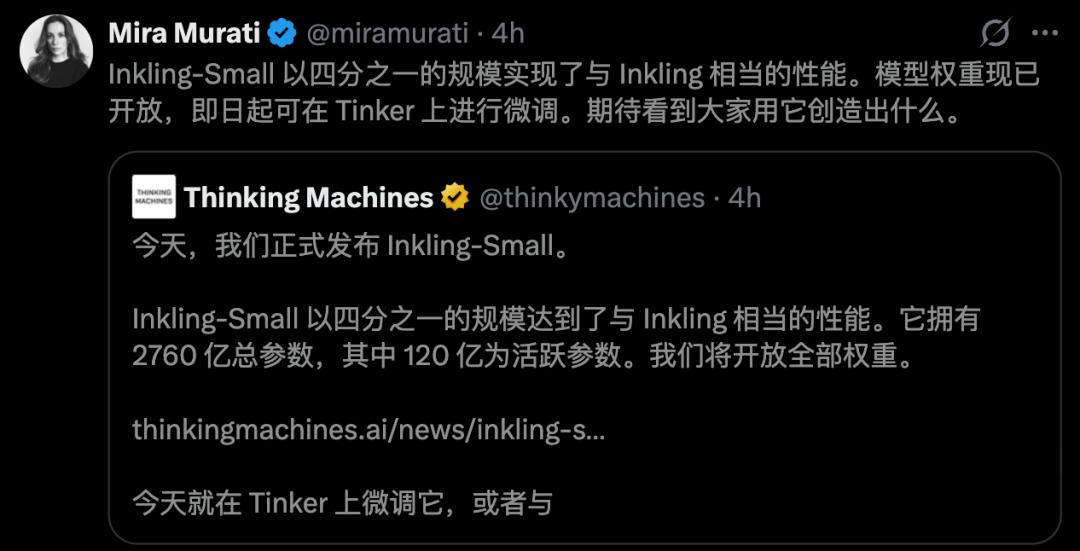
Thinking Machines发布了第二款重磅模型Inkling-Small1。这款模型总参数量为276B,激活参数仅12B,体量为初代Inkling的四分之一1。该模型采用MoE架构,具备原生多模态能力和100万token上下文1,在ARC-AGI-2等核心指标上刷新开源SOTA1,并在数学、推理、智能体编码、多模态基准中的性能堪比或超越初代Inkling和DeepSeek V4 Flash1。
Inkling-Small的训练采用了创新方法,先由初代Inkling进行on-policy蒸馏生成preview检查点,随后进行两周的智能体编码强化学习1。模型的硬件部署门槛明显降低,BF16检查点从2TB降至NVFP4量化版600GB起步,使中等规模团队也可进行模型定制1。
翁荔官宣离职仅两天后,OpenAI证实其已回归并带队攻坚「递归自我提升」(RSI)研究1。Thinking Machines六位联创中已有四人先后离职回归OpenAI,其中包括Barret Zoph、Luke Metz和翁荔1。
Thinking Machines has released Inkling-Small, its second major large language model, featuring 276 billion total parameters with 12 billion activated parameters 1. The model employs a mixture-of-experts architecture, incorporates native multimodal capabilities, and supports a context window of one million tokens 1. According to performance benchmarks, Inkling-Small achieves state-of-the-art results on open-source metrics including ARC-AGI-2 and matches or exceeds the capabilities of its larger predecessor Inkling and DeepSeek V4 Flash across mathematics, reasoning, agent coding, and multimodal tasks 1.
The model's development employed a two-stage training methodology: the team first conducted on-policy distillation using Inkling to generate preview checkpoints, followed by two weeks of reinforcement learning focused on agent coding 1. Notably, the hardware requirements have been significantly reduced—the BF16 checkpoint has been scaled down from 2 terabytes to 600 gigabytes using NVFP4 quantization, enabling mid-sized teams to perform model customization 1.
The launch comes just two days after co-founder Weng Li announced his departure, with OpenAI subsequently confirming his return to lead efforts on "recursive self-improvement" (RSI) 1. This development reflects organizational changes at Thinking Machines, where four of the company's six co-founders have now left to rejoin OpenAI, including Barret Zoph, Luke Metz, and Weng Li 1.
评论
还没有评论,欢迎留下第一条。