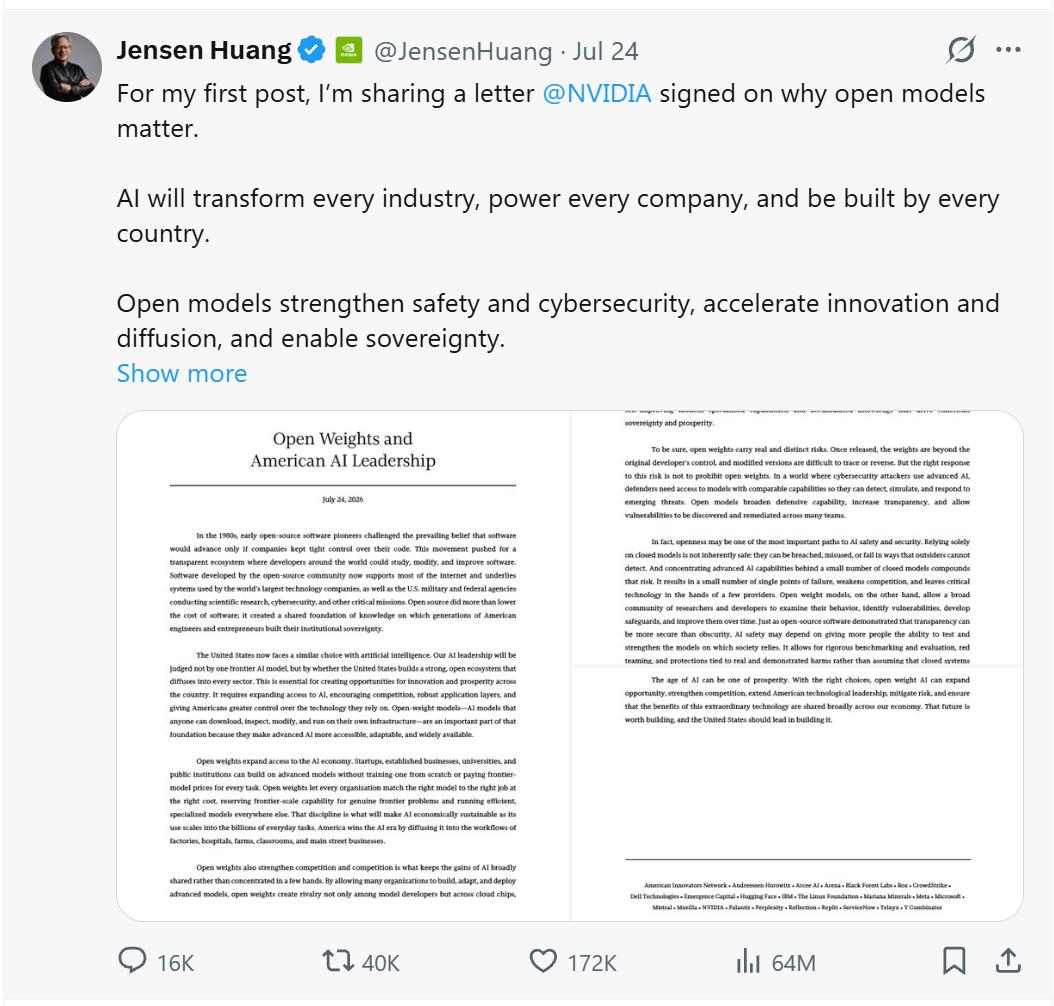
英伟达CEO黄仁勋近日连续发起AI安全倡议。他发布了由32家公司联署的公开信,主张AI安全防御需要依靠开源工具和模型1。随后,他宣布成立"开源安全AI联盟"(Open Secure AI Alliance),该联盟获得37家创始成员的加入1。英伟达还开源了NOOA框架(NVIDIA Labs Object-Oriented Agent),在SWE-bench Verified基准测试中达到82.2%的准确率,CyberGym L1解决率为86.8%,同时token消耗仅为竞品的一半1。
在这波倡议中,主要的大型AI公司态度各异。OpenAI和Google均在黄仁勋的公开信上署名,但两家公司都未选择加入新成立的联盟1。Anthropic的立场最为突出——该公司既未在公开信上签署,也未加入联盟1。Anthropic CEO Dario Amodei发表声明指出,公司不认为"开放能让防御者更安全",反而主张通过芯片封锁、杜绝蒸馏和加强安全测试等手段来加强AI安全1。
NVIDIA CEO Jensen Huang has released an open letter and announced the formation of the Open Secure AI Alliance to advance AI safety through open-source tools and models 1. The initiative has attracted 37 founding members, though responses from major AI companies vary significantly 1.
The open letter, co-signed by 32 companies, endorses the use of open-source models as a cornerstone of AI security defense 1. NVIDIA has open-sourced the NOOA framework (NVIDIA Labs Object-Oriented Agent), achieving an 82.2% success rate on SWE-bench Verified and an 86.8% resolution rate on CyberGym L1, while consuming only half the tokens of competing solutions 1.
The response from leading AI companies has been mixed 1. OpenAI and Google signed the public letter supporting the initiative but did not join the alliance 1. Anthropic, however, declined to participate in either the letter or the alliance 1. Anthropic CEO Dario Amodei released a statement opposing the open-source approach, arguing that "openness does not make defenders safer" 1. Instead, Anthropic advocates for chip restrictions, prevention of model distillation, and strengthened safety testing 1.
评论
还没有评论,欢迎留下第一条。