高通于当地时间7月24日向全球客户下发涨价通知,宣布自9月1日起对全系芯片产品实施两位数幅度涨价1。其中骁龙8 Elite Gen 6 Pro的涨幅最高可达18%1。高通首席执行官安蒙表示,此次涨价的核心目的是对冲全产业链成本上行压力1。
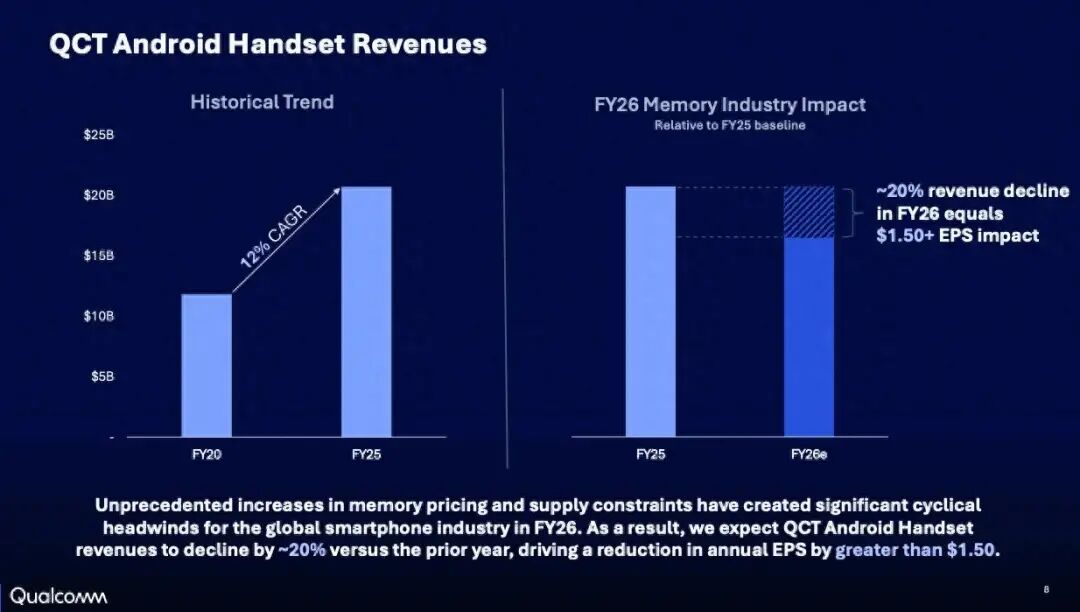
这一决定直接冲击了安卓手机厂商的成本端。小米、OPPO、vivo等品牌纷纷下调订单,其中中低端机型订单降幅最高达20%1。与此同时,拥有自研芯片优势的华为和苹果市占率反而增长1。高通面临的成本压力确实严峻:2026财年第三财季营收99.47亿美元,同比增长4%,但净利润同比大幅下滑25%1;手机业务营收更是同比暴跌20%,创下2021年以来最低纪录1。产业链上游成本持续攀升,2026年一季度通用DRAM合约价季增93%-98%,NAND Flash合约价季增55%-60%1,而台积电2nm先进制程晶圆成本已突破3万美元1。由此带来的连锁反应是手机物料成本结构的剧变,存储占比从原来的10%-15%飙升至30%以上1。
当前国内智能手机市场也面临下行压力,2026年二季度出货量同比下滑4.3%,已连续五个季度同比下跌1。不过高通汽车业务保持强劲势头,已实现连续23个季度两位数同比增长1。
Qualcomm notified global customers of a price increase across its full chip product lineup, effective September 1st, with the Snapdragon 8 Elite Gen 6 Pro seeing the steepest jump of up to 18% 1. The chipmaker issued the notice on July 24th, citing the need to offset cost pressures throughout the supply chain and restore profit margins 1. CEO Amon stated that the core rationale for the price increase is to counteract rising costs across the entire industrial chain 1.
The price hike is already impacting Android device makers, with Xiaomi, OPPO, and Vivo reducing orders for mid-range and entry-level phone models by as much as 20% 1. Meanwhile, manufacturers with in-house chip capabilities, including Huawei and Apple, have seen their market share grow amid the pricing pressure 1. The timing of the increase reflects broader industry challenges, including a 4.3% year-over-year decline in domestic smartphone shipments in the second quarter of 2026, marking the fifth consecutive quarter of decline 1.
Qualcomm's latest earnings underscored the sector's difficulties, with fiscal 2026 third-quarter revenue reaching $9.947 billion, up 4% year-over-year, but net income plummeting 25% 1. Smartphone business revenue fell sharply by 20%, hitting its lowest level since 2021 1. Supply chain pressures have intensified further, with memory storage costs in phone components surging from 10–15% to over 30% of total material costs 1. Industry-wide, DRAM contract prices are projected to rise 93–98% sequentially in the first quarter of 2026, while NAND Flash prices are expected to climb 55–60% 1. Advanced manufacturing costs have also soared, with Taiwan Semiconductor Manufacturing Company's 2nm process wafers exceeding $30,000 per unit 1. Qualcomm's automotive division has proven resilient, achieving consecutive double-digit year-over-year growth for 23 quarters 1.
评论
还没有评论,欢迎留下第一条。