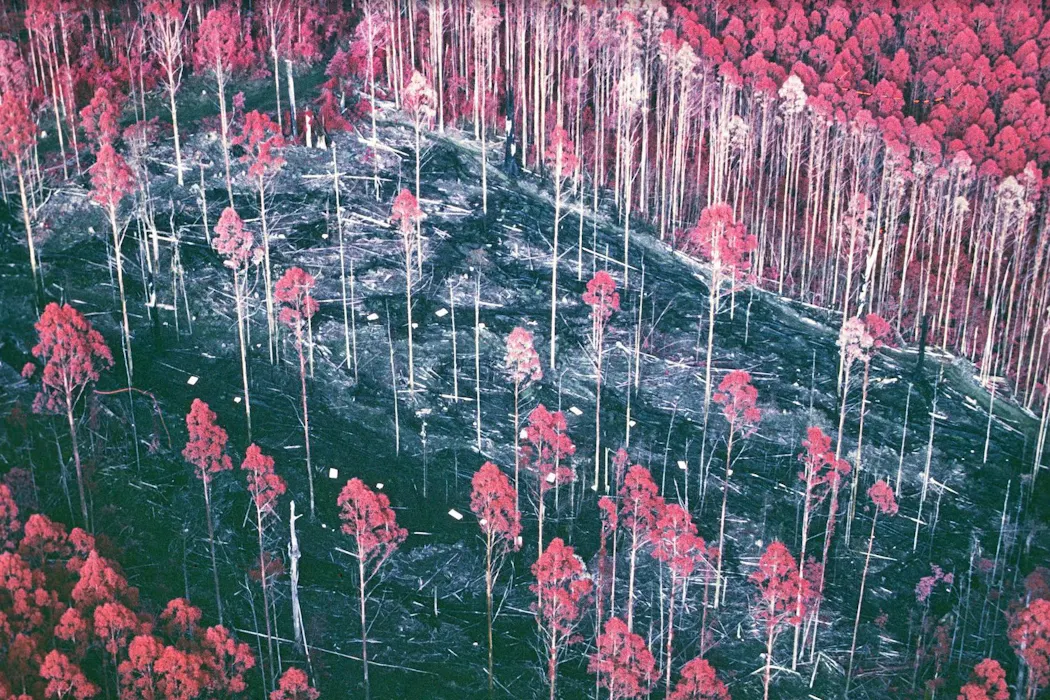
研究人员在2014年重新访问了一项在澳大利亚维多利亚州进行的长期森林管理实验,发现了令人瞩目的结果。1这项名为"林业系统项目"的试验在1987至1989年间于Tanjil Bren和Cabbage Tree Creek两处建立,投入相当于今天的2600万澳元,用于比较不同采伐方式对山灰木森林再生的影响。1该项目评估了三种采伐策略——大面积皆伐、小面积皆伐和重度疏伐——的长期效果。
经过30年的时间验证,重度疏伐区域展现出了显著优势。1该处理方式产生的树木平均直径超过1米,最大甚至超过1.5米,比未收获对照区大约20%。1令人意外的是,这些生长更快、体型更大的树木在碳储存能力上与完全未干扰的对照区相当或更优。1同时,重度疏伐林分为生态系统提供了额外的生态价值——通过相机陷阱监测发现,濒危物种Leadbeater's possum在所有林业处理地块中都有活动记录,但在未收获区域则没有发现。1
尽管这些研究发现早在21世纪初已被发表,但该项目之后长期被忽视,直到2014年的重新访问才重获关注。1
A team of researchers returned to a long-abandoned forestry study in Victoria's Central Highlands to evaluate three decades of outcomes from the Silvicultural Systems Project.1 The experiment, originally established between 1987 and 1989 at Tanjil Bren and Cabbage Tree Creek with funding equivalent to AUD 26 million in today's dollars, compared the effects of three different harvesting methods—clear-felling on large areas, clear-felling on small areas, and heavy thinning—on mountain ash forest regeneration.1
The findings challenged conventional forestry wisdom. Trees in the heavily thinned plots grew substantially larger, with average diameters exceeding one meter and some reaching over 1.5 meters—approximately 20 percent larger than those in unharvested control areas.1 Most significantly, after just three decades, the heavily thinned forest stored the same amount or more carbon than the unharvested control plots, while also proving more fire-resistant.1 Additionally, camera traps revealed that Leadbeater's possums, an endangered species, were present across all managed forest plots but absent from the unharvested areas, indicating that heavy thinning provided superior habitat for the species.1
The original research findings were published in the early 2000s but subsequently fell into obscurity until the project was revisited in 2014.1
评论
还没有评论,欢迎留下第一条。