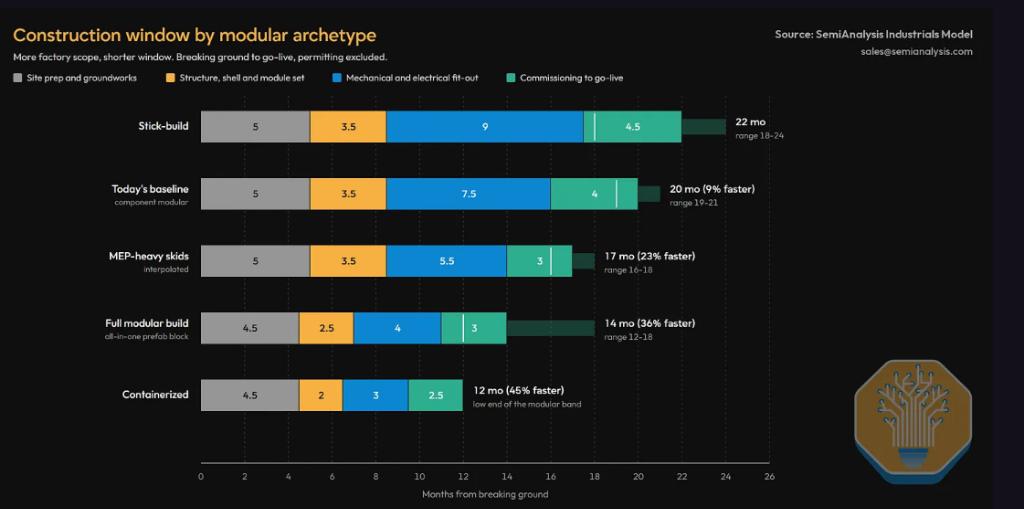
研究机构SemiAnalysis发布报告指出,AWS和Meta等超大规模云厂商正推行模块化数据中心建设方案1。该方案通过在工厂预制标准化组件并实施并行施工,可将建设周期压缩约36%,相当于缩短7至9个月1。同时,综合资本开支每兆瓦可降低约8%1,全模块化方案综合费用约为每兆瓦1350万美元,低于纯现场建设的约1460万美元1。
模块化建设方案在实践中已取得显著效果。AWS的"Project Houdini"项目已实现大规模应用,将白空间建设准备时间从最长15周压缩至2至3周1。Meta在俄亥俄州New Albany的Prometheus园区自2025年7月宣布建设至2026年4月已有8座结构竣工1。该方案还显著缓解了电气工人短缺问题——电气工人占数据中心项目全部建设工时的30%至40%1,模块化方案现场工时下降约63%至每兆瓦4500小时1。
根据预测,到2028年底,模块化建设占全部在线容量的比例将突破30%1。
Research firm SemiAnalysis has released findings showing that hyperscale cloud operators including AWS and Meta are deploying modular data center construction methods that substantially reduce both development timelines and capital expenditures.1 According to the analysis, this approach compresses construction cycles by approximately 36%—equivalent to shortening projects by 7 to 9 months—while reducing aggregate capital expenditure per megawatt by about 8%.1
The modular strategy achieves these gains through factory-based prefabrication of standardized components coupled with parallel construction workflows, significantly alleviating labor bottlenecks in the electrical trades.1 AWS's "Project Houdini" initiative and Meta's Prometheus campus in New Albany, Ohio exemplify large-scale deployment of this method.1 AWS has compressed white space preparation from as long as 15 weeks down to 2 to 3 weeks, while Meta's Ohio facility logged 8 completed structures between its July 2025 announcement and April 2026.1 Electrical workers typically account for 30 to 40 percent of total construction labor hours on data center projects, making workforce constraints a critical bottleneck that modular construction helps resolve.1
The fully modular approach reduces on-site labor intensity to approximately 4,500 hours per megawatt, down roughly 63 percent from conventional build methods.1 Total costs for the modular model reach approximately $13.5 million per megawatt, undercutting the roughly $14.6 million per megawatt required for purely site-built facilities.1 Industry projections suggest that by the end of 2028, modular construction will account for more than 30 percent of all newly online data center capacity.1
评论
还没有评论,欢迎留下第一条。