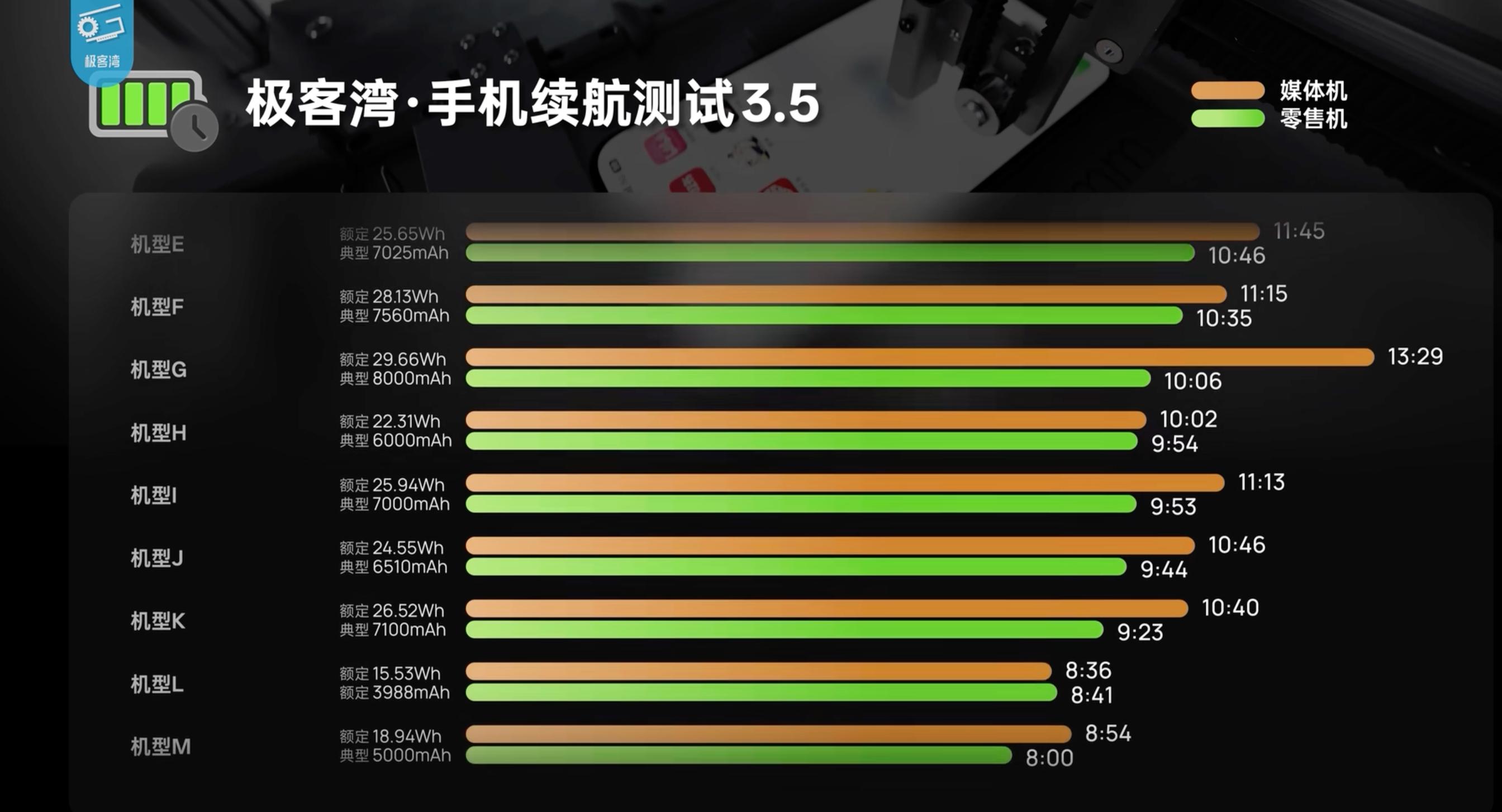
评测博主极客湾通过专业测量发现,市面大多数零售手机存在电池"锁容"现象1。实际可用容量低于厂商标称值,容量释放率普遍在87%-95%之间1。以一款标称10000mAh的手机为例,实际可用电量仅为8500mAh出头1。相比之下,iPhone 17 Pro Max的容量释放率达到97.83%1,华为Mate 70 Pro+和Mate 80 Pro的释放率接近100%1,三星S26 Ultra超过98%1。
华为终端BG CTO李小龙对此现象作出解释1。他表示,这是因为高硅负极电池普及后,很多厂商的电源管理芯片未做低压适配,导致电池底部电量被浪费1。华为早在两年多前就预判到高硅电池会成为主流,提前完成了系统适配,将关机电压降至2.8V1。相比之下,苹果和三星尚未上马硅负极电池,主要是考虑国际物流成本的影响1。
Tech reviewer GeekBay has uncovered a widespread "battery capacity lock" phenomenon affecting most retail smartphones, wherein the actual usable battery capacity falls significantly below manufacturers' stated specifications 1. Through professional measurements, the reviewer found that capacity release rates typically range between 87% and 95% across most tested models 1. For instance, a smartphone marketed with a 10,000mAh battery can deliver only slightly over 8,500mAh of actual usable power 1.
However, flagship models from major manufacturers demonstrate notably better performance 1. The iPhone 17 Pro Max achieves a capacity release rate of 97.83%, while both the Huawei Mate 70 Pro+ and Mate 80 Pro approach 100% 1. Samsung's S26 Ultra similarly exceeds 98% 1. According to Huawei Terminal Business Group CTO Li Xialong, the disparity stems from the adoption of high-silicon anode batteries across the industry 1. Huawei anticipated this transition over two years ago and proactively adapted its power management systems, lowering the phone's shutdown voltage to 2.8V to optimize battery utilization 1. Meanwhile, Apple and Samsung have not yet deployed silicon anode batteries, primarily due to concerns over international logistics costs 1.
评论
还没有评论,欢迎留下第一条。