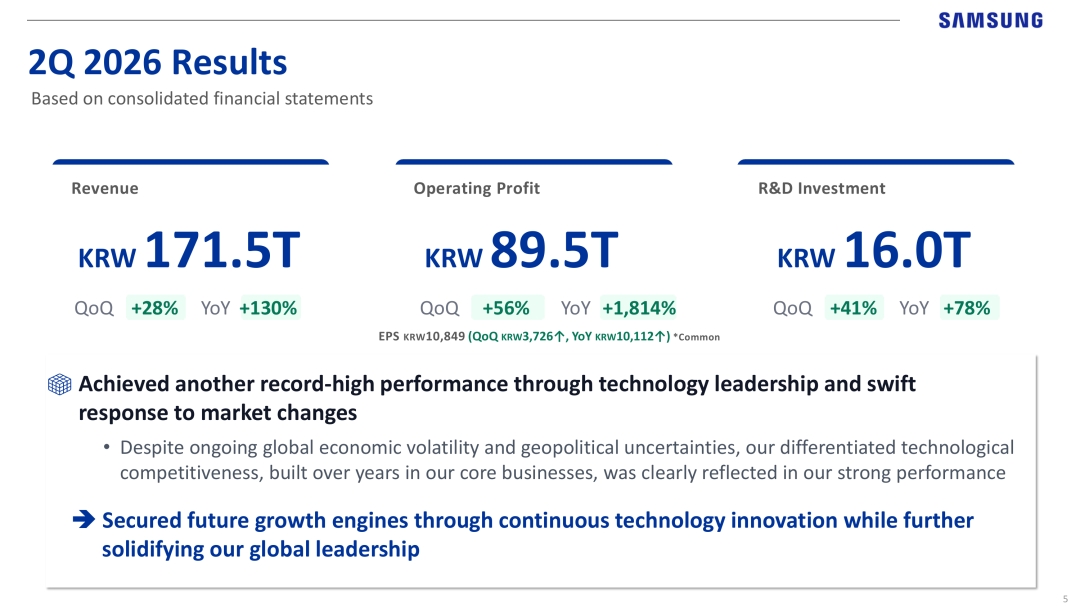
三星电子公布的二季度财报显示成绩亮眼,营收达171.5万亿韩元,同比增长130%1;营业利润89.5万亿韩元,同比激增1814%,创造历史新高1;净利润为71.6万亿韩元1。存储芯片业务成为业绩增长的主要驱动力,存储部门营收120.8万亿韩元,环比增长62%、同比增长471%1,贡献了全公司99%的利润1。其中DRAM合约价环比上涨58-63%,NAND合约价环比上涨70-75%1,三星传统DRAM体量最大因此受益最丰1。
然而亮眼财报并未给投资者带来信心,股价反而从6月高点下跌四成1。市场对利润增长的持续性存疑——分析机构TrendForce预计第三季度DRAM合约价环比涨幅将收窄至13-18%,NAND涨幅也将降至10-15%1。财报发布前三个月内股价累计上涨66%,但预告当日即下跌6.9%1。此外,三星的利润结构显得单一脆弱,同期其他业务陷入困境——DX部门从去年同期盈利3.3万亿韩元转为亏损0.8万亿1,手机业务(MX/NW)亏损0.7万亿韩元1。三星在存储领域的HBM4芯片方面仍保持竞争力,第一季度市场份额约21%1,公司计划从第三季度起HBM4占自家HBM销售过半,2026年HBM营收要达到2025年的3倍以上1。
Samsung Electronics reported extraordinary second-quarter results, with operating profit reaching 89.5 trillion Korean won, up 1,814 percent year-over-year and marking an all-time high 1. Revenue for the period totaled 171.5 trillion won, a 130 percent increase compared to the same quarter last year, while net profit climbed to 71.6 trillion won 1.
The stellar earnings were heavily concentrated in the company's memory semiconductor division, which generated 120.8 trillion won in revenue—up 62 percent sequentially and 471 percent annually—and accounted for 99 percent of total company profits 1. Storage chip contract prices surged dramatically, with DRAM rising 58 to 63 percent quarter-over-quarter and NAND flash jumping 70 to 75 percent, benefiting Samsung's traditional DRAM business particularly due to its large market share 1. The company achieved approximately 21 percent market share in HBM4 chips during the first quarter and projected that HBM4 would represent over half of its HBM sales beginning in the third quarter, with revenue plans to more than triple HBM revenue compared to 2025 levels by 2026 1.
Despite the record profitability, investors reacted negatively to the earnings announcement. Samsung's stock price fell 6.9 percent on the day the earnings were disclosed, reversing momentum from the preceding three months when shares had risen 66 percent, and has since declined 40 percent from its June peak 1. Market participants cited concerns about decelerating price increases, a narrow profit structure overly dependent on memory chips, and limited transparency surrounding long-term supply contracts 1. Industry analyst TrendForce projected that price increases would moderate significantly in the third quarter, with DRAM contract prices expected to rise only 13 to 18 percent and NAND prices 10 to 15 percent 1.
Other divisions reported losses: the Device Experience division shifted from a 3.3 trillion won profit a year earlier to an 800 billion won loss, while the Mobile Experience and Network divisions posted a combined 700 billion won loss 1. Samsung and its labor union had agreed in May to allocate 10.5 percent of the Device Solutions division's annual operating profit as special performance bonuses, resulting in a provision of 17 to 19 trillion won for the current quarter 1.
评论
还没有评论,欢迎留下第一条。