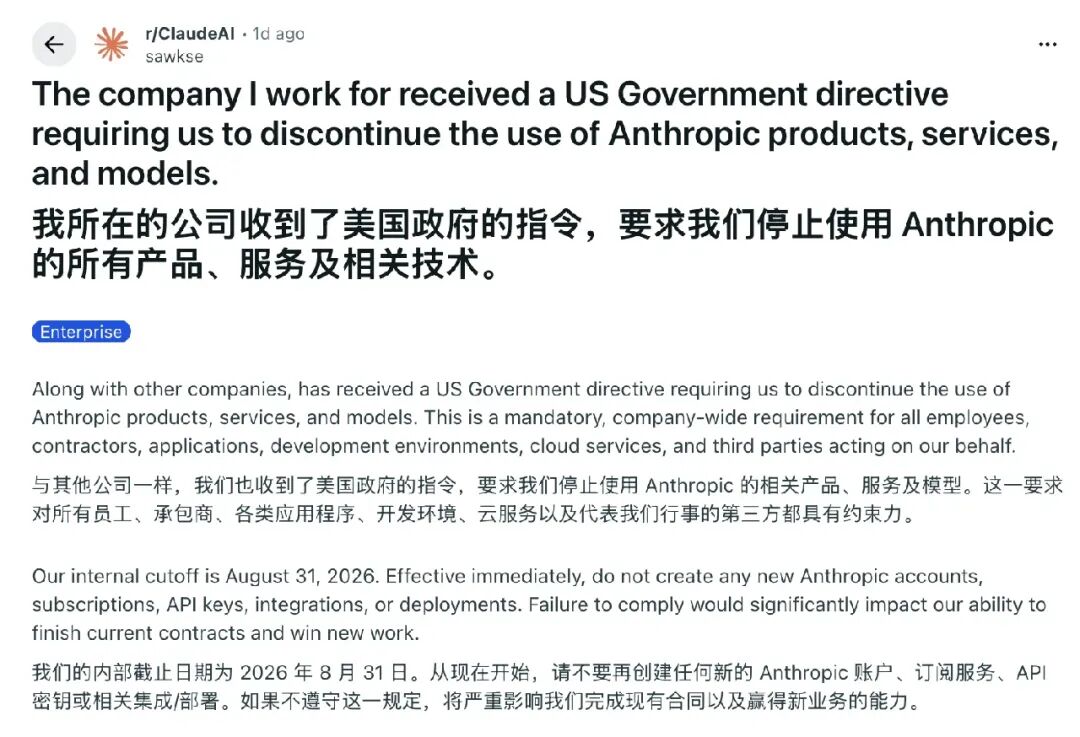
美国政府承包商收到强制性指令,要求停止使用Anthropic旗下的Claude全线产品和服务,迁移截止日期为2026年8月31日1。禁用范围涵盖Claude网页端、桌面应用、Claude Code以及Claude Opus、Sonnet、Haiku等全系列模型1,相关公司已被要求将员工迁移至OpenAI、Nemotron和Grok等替代方案1。
硅谷对Anthropic的反弹情绪日趋激烈,多重因素共同推动这一局面。Anthropic发布的Claude Design产品与合作伙伴Figma直接竞争,引发业界担忧其可能"反向吃掉"合作方1。公司调整的数据留存政策也成为焦点——Fable和Mythos系列请求输出保留期限从30天到2年不等,激发了数据安全方面的隐忧1。此外,Anthropic是唯一未签署《开放权重与美国AI领导力》公开信的主要前沿模型实验室,这一立场遭到业界批评1。2月份五角大楼将Anthropic列入黑名单,原因是该公司对Claude用于大规模监控或自主武器的反对立场1。
U.S. government contractors have been directed to cease using all Anthropic products and services, with a mandatory migration deadline of August 31, 2026.1 The prohibition covers Claude's entire product line, including the web interface, desktop applications, Claude Code, and all model variants—Claude Opus, Sonnet, and Haiku.1 Affected companies have been instructed to transition to alternative solutions such as OpenAI, Nemotron, and Grok.1
The directive coincides with mounting tensions between Anthropic and the Silicon Valley tech community. Anthropic's launch of Claude Design, developed in direct competition with partner Figma, has raised concerns among collaborators about being "reverse acquired."1 Additionally, Anthropic's revised data retention policy, which now stores outputs from its Fable and Mythos model series for periods ranging from 30 days to two years, has triggered data security concerns within the industry.1 Anthropic stands alone among major frontier AI laboratories in refusing to sign the "Open Weights and American AI Leadership" public letter, drawing criticism from the broader research community.1 The tension reflects earlier friction, as Anthropic was added to the Pentagon's blacklist in February over its opposition to using Claude for mass surveillance or autonomous weapons applications.1
评论
还没有评论,欢迎留下第一条。