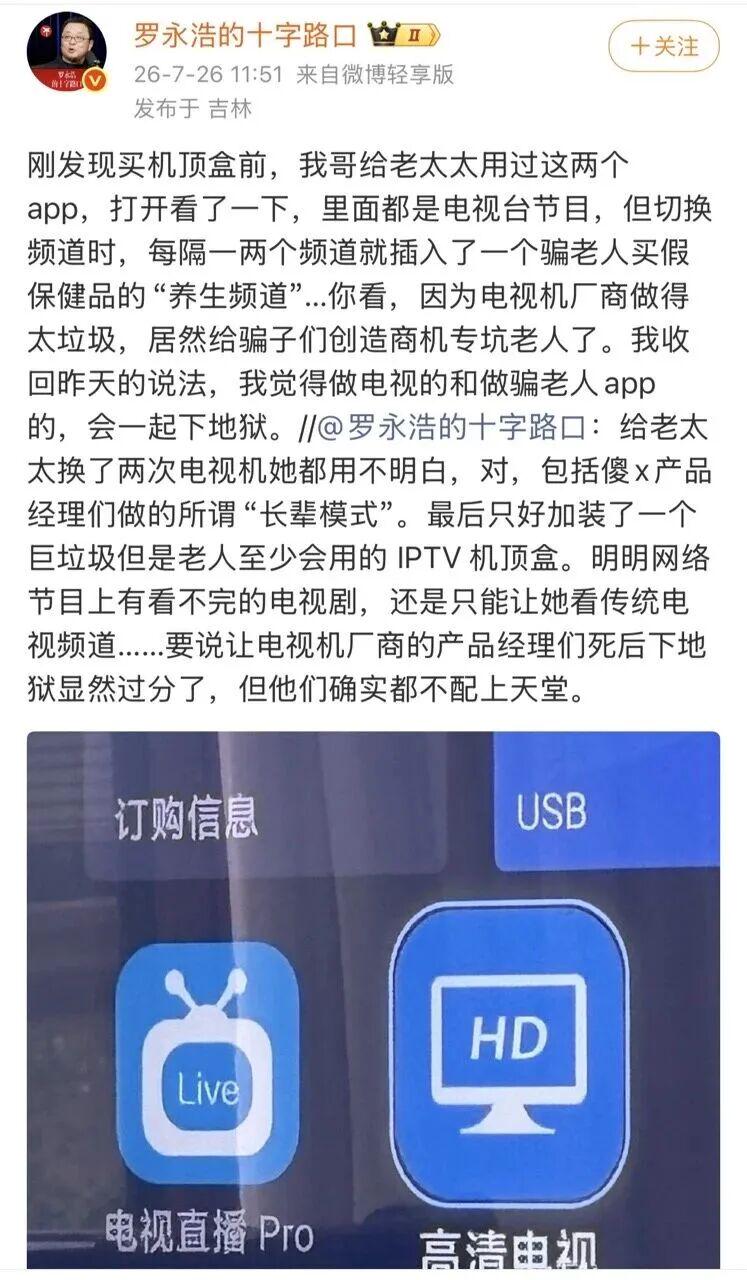
罗永浩因家中老人无法使用新款智能电视而公开批评行业现状。他先后购买的两台新款智能电视都因操作过于复杂而无法被老人使用,最终不得不装回IPTV机顶盒1。这一个人经历揭示的是整个智能电视行业的系统性问题:市面上所有电视的适老化改造都只停留在表面,仅仅简单放大字体、调亮屏幕,而对核心操作逻辑和广告弹窗等关键问题置之不理1。
罗永浩认为,这不是技术难题,而是厂商的商业选择。他指出,"十几年前业内就有人想过把电视做成极简模式,但厂商根本不想做"1。这种现象的根本原因在于商业模式的扭曲:智能电视硬件利润极低,厂商的真正收入来源是开机广告、弹窗推广、会员充值和应用下载分成1。整个智能硬件行业都存在类似通病,为了降低成本和优化商业收益,企业普遍不愿投入改善基础用户体验1。
国内智能产品的适老化要求目前基本都是倡导性建议,缺乏硬性标准、落地细则和处罚机制1,这使得企业在优化用户体验方面缺少实质压力。
Luo Yongzhao, a prominent technology entrepreneur, has publicly criticized smart television manufacturers for prioritizing profit over usability, after struggling to set up new TV models for elderly family members 1. He purchased two modern smart TVs but ultimately had to revert to using an IPTV set-top box because the elderly residents could not navigate the complex interfaces 1.
The core issue, according to Luo, extends far beyond cosmetic design choices. He pointed out that industry-wide "aging adaptation" efforts amount to nothing more than enlarging text and brightening screens, while leaving the fundamental operational logic and intrusive advertising untouched 1. "People in the industry conceived of a simplified mode for televisions over a decade ago, but manufacturers simply have no incentive to build it," he stated 1. The real revenue streams for smart TV makers come from boot-up advertisements, pop-up promotions, subscription fees, and app download commissions—not from hardware sales, which carry minimal profit margins 1.
Luo's critique reflects a systemic problem in China's smart hardware sector: aging-friendly requirements are merely advisory guidelines with no mandatory standards, implementation details, or enforcement mechanisms 1. Manufacturers treat user experience improvements as unnecessary costs rather than essential features, deliberately designing complexity to drive engagement and monetization.
评论
还没有评论,欢迎留下第一条。