Meta第二季度营收608.01亿美元,同比增长28%,超过华尔街预期1。其中广告收入593.63亿美元,同比增长27%1。然而财报发布后,公司股价盘后跌幅一度接近9%,最终收于585.61美元1。
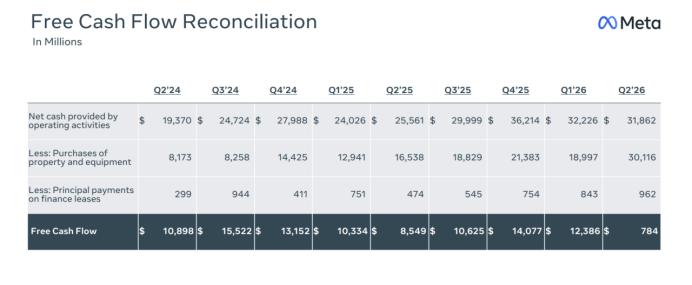
利润增长被巨额资本开支侵蚀成为股价下跌的主要原因。本季度资本开支高达310.78亿美元,经营现金流318.62亿美元,导致自由现金流仅7.84亿美元1。Meta同时上调了未来资本支出计划,将2026年资本开支下限从1250亿美元提高至1300亿美元,最高可能达到1450亿美元1。第二季度研发费用同比增长67%,达216.56亿美元1,而长期债务也较去年年底增加249.2亿美元,达836.64亿美元1。公司本季度未进行股票回购1。
这一系列投入主要用于支撑AI基础设施扩建。一年前扎克伯格曾斥资143亿美元入股Scale AI,并将28岁的汪滔请进Meta领导AI团队1。该团队已推出Muse Spark系列模型,其中Muse Spark 1.1将Artificial Analysis综合指数从43分提高到51分1。然而真正的旗舰模型Watermelon仍在训练中,使用的算力比Muse Spark高一个数量级,已在部分基准评测中追上GPT-5.51。巨额投入是否能产生相应的商业回报仍待验证。
Meta reported strong second-quarter results with revenue reaching $608.01 billion, representing 28% year-over-year growth and surpassing Wall Street expectations 1. However, the company's stock price dropped nearly 9% in after-hours trading following the earnings announcement 1, closing at $585.61 on the day 1.
The selloff was driven by concerns over Meta's escalating capital expenditure commitments. The company spent $310.78 billion on capital expenses in the quarter, leaving only $7.84 billion in free cash flow despite generating $318.62 billion in operating cash flow 1. More significantly, Meta raised its 2026 capital expenditure guidance floor from $125 billion to $130 billion, with a potential high-end of $145 billion 1. Research and development expenses surged 67% year-over-year to $216.56 billion 1, while advertising revenue grew 27% to $593.63 billion 1.
The aggressive spending reflects Meta's massive investment in AI infrastructure under the leadership of Wang Tao, a 28-year-old executive whom CEO Mark Zuckerberg recruited after spending $14.3 billion to invest in Scale AI one year prior 1. Wang's team has released the Muse Spark model series, with Muse Spark 1.1 improving the Artificial Analysis composite score from 43 to 51 points 1. However, the flagship model Watermelon remains in training and has yet to justify the $14.3 billion investment and reorganization costs, though reports indicate it uses an order of magnitude more computing power than Muse Spark and has already caught up to GPT-5.5 on some benchmark evaluations 1. Meta's long-term debt reached $836.64 billion, an increase of $249.2 billion from year-end, and the company did not conduct stock buybacks during the quarter 1.
评论
还没有评论,欢迎留下第一条。