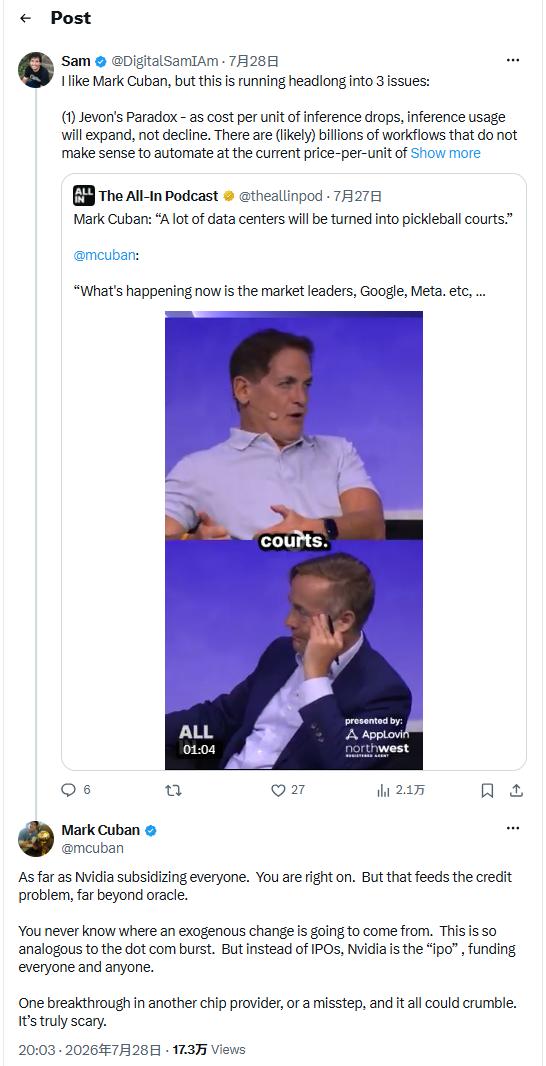
华尔街投资人马克·库班和迈克尔·伯里近期对英伟达的商业模式提出警告。1库班指出,英伟达通过资助客户购买GPU和提供融资,使整个AI生态形成了过度依赖,他表示"这与互联网泡沫破裂非常相似。但不同于当时有大量IPO,英伟达本身就是'IPO',它为所有人提供资金。"1他进一步警告,"其他芯片供应商的一次突破,或者一次失误,都可能导致整个体系崩溃,这真的很可怕。"1
伯里在财务指标上发现了风险信号。1他指出英伟达五年期信用违约互换价格在过去两个月内大约翻了一番,表明市场对其财务风险的评估正在上升。1伯里于7月24日增持了英伟达空头头寸,并持有"相当数量的"看跌期权。1与此同时,英伟达股价周三下跌逾3%,今年迄今几乎持平。1
对于这些批评,英伟达首席执行官黄仁勋则声称"我们基本上是在维系着地球——这并非不实之词"。1
Prominent Wall Street investors Mark Cuban and Michael Burry have raised concerns about Nvidia's business model, arguing that the chipmaker has created excessive dependency across the entire AI industry through a risky financing strategy.1 Cuban characterized the situation as reminiscent of the internet bubble, noting that "this is very similar to the internet bubble bursting. But unlike the large number of IPOs at that time, Nvidia itself is the 'IPO'—it provides financing for everyone."1 He further warned that "a breakthrough by another chip supplier, or a single mistake, could cause the entire system to collapse, which is really terrifying."1
Burry has substantiated his concerns with market data, pointing out that Nvidia's five-year credit default swap price has roughly doubled over the past two months, indicating that markets have reassessed the company's financial risk.1 On July 24, Burry increased his short position on Nvidia and holds "a considerable amount of" put options against the stock.1 Nvidia's share price declined over 3 percent on Wednesday and has remained nearly flat year-to-date.1
评论
还没有评论,欢迎留下第一条。