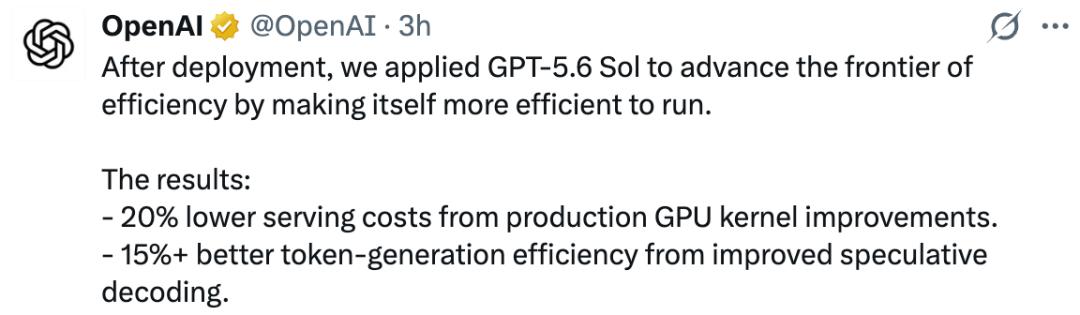
OpenAI公布了GPT-5.6系列模型的自进化优化成果。1在技术性能方面,推理服务部署成本下降20%,整体token生成效率提升超15%。1该公司还通过推测解码技术优化进一步提升预测模型效率15%以上,在ARC-AGI-3测试中启用推理记忆留存与上下文压缩后,模型评测分数提升至原先3倍,同时输出token消耗量缩减为1/6。1GPT-5.6 Sol在Artificial Analysis编程智能体评测中性能优于Claude Fable 5。1
与此同时,OpenAI宣布Thinking Machines Lab联合创始人翁荔重新加入公司。1翁荔于7月27日公开发布离职告别信,7月28日是其在Thinking Machines的最后工作日。2仅一天后,7月29日OpenAI确认其已重返,将负责领导支持递归自我改进等跨研究工作的高层级团队。2翁荔在离职信中表示,过去七个月里自己生病的频率和严重程度超过人生中的任何阶段,并表示希望下一份工作是"职责范围更清晰、环境更可预测,而且不是联合创始人"的角色。2
此外,OpenAI透露用户规模首次突破10亿人,服务200万家企业。1公司还宣布正打造AI硬件产品,用户可能很快见到。1
OpenAI has announced significant technical advancements in its GPT-5.6 model series, achieving a 20% reduction in inference service deployment costs and improving overall token generation efficiency by over 15% 1. The company also revealed progress in speculative decoding technology, which boosted predictive model efficiency by more than 15% 1. In ARC-AGI-3 testing, after implementing reasoning memory retention and context compression techniques, model evaluation scores improved threefold while output token consumption dropped to one-sixth of previous levels 1.
The announcements coincide with OpenAI's confirmation that Lilian Weng, former Vice President of Research and Safety, is rejoining the company to lead a high-level internal research team supporting recursive self-improvement and other cross-research initiatives 2. Weng departed from Thinking Machines Lab on July 28 citing health concerns, having disclosed in her resignation letter that over the past seven months she experienced illness frequency and severity exceeding any previous period in her life 2. She expressed a desire for her next role to have clearer responsibilities in a more predictable environment while not serving as a co-founder 2.
OpenAI reported that its user base has surpassed the 1 billion milestone for the first time, serving 2 million enterprises 1. The company also signaled plans to develop AI hardware products, stating users may see these offerings soon 1.
评论
还没有评论,欢迎留下第一条。