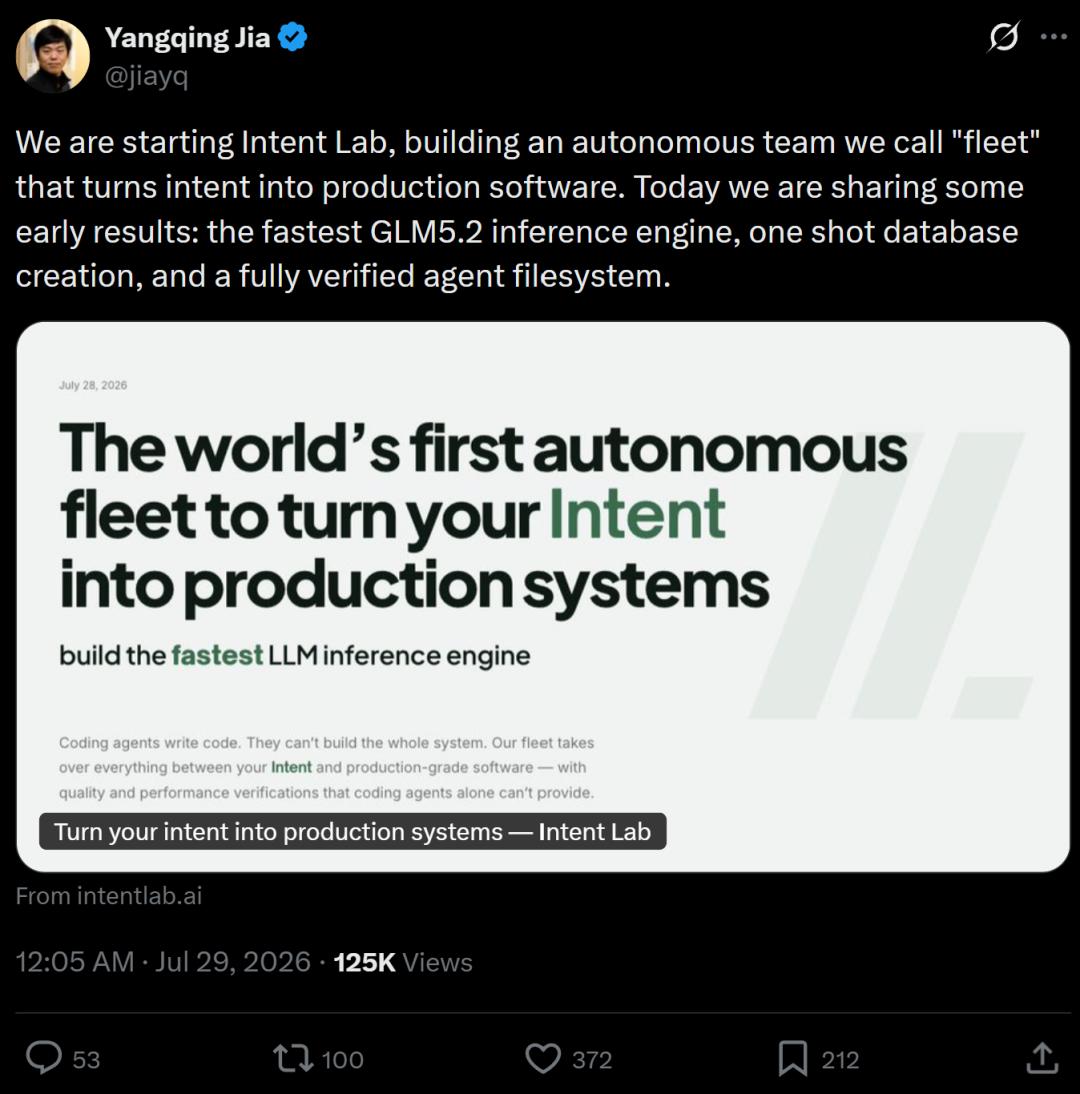
AI研究人员贾扬清离开英伟达约一个月后创办了Intent Lab,并启动了名为Fleet的自主AI团队项目1。该项目旨在将用户意图转化为生产级软件系统,通过多项技术突破展示了AI在完整软件工程流程中的能力1。
Fleet在推理优化方面取得显著成效1。通过优化TensorRT-LLM,该团队使GLM-5.2的推理速度从102token/s提升至647token/s,实现了534%的性能提升1。
在数据库开发方面,Fleet从零开始构建了SQLite兼容数据库,产生8720万个输出token,通过了全部600万项验收测试1。该项目使用Opus 4.8的成本约2000美元,若采用开源模型成本可降至约350美元1。同时,Fleet还创建了分布式文件系统AgentFS,目录状态查询速度达到EFS的626倍,文件状态查询速度达到EFS的625倍1。在测试中,Fleet检查了约190万个可达状态,完成了约300项集成测试1。
Jia Yangqing, an AI researcher who recently left NVIDIA, has founded Intent Lab and unveiled Fleet, an autonomous AI team designed to transform user intent into production-grade software systems 1. The project has demonstrated significant technical achievements across multiple domains, showcasing AI's capacity to execute complete software engineering workflows.
Fleet has delivered three major technical accomplishments. The team optimized TensorRT-LLM to accelerate GLM-5.2 inference speed from 102 tokens per second to 647 tokens per second, representing a 534% improvement 1. Additionally, Fleet built a SQLite-compatible database from scratch that passed all 6 million acceptance tests, consuming 87.2 million output tokens with estimated costs of approximately 2,000 US dollars using Opus 4.8 or around 350 US dollars with open-source models 1. The team also created AgentFS, a distributed file system that vastly outperforms comparable solutions, achieving directory status query speeds 626 times faster than EFS and file status query speeds 625 times faster than EFS 1.
The project involved extensive testing and validation, with Fleet examining approximately 1.9 million reachable states and completing around 300 integration tests 1. Jia Yangqing launched Intent Lab approximately one month after departing from NVIDIA 1.
评论
还没有评论,欢迎留下第一条。