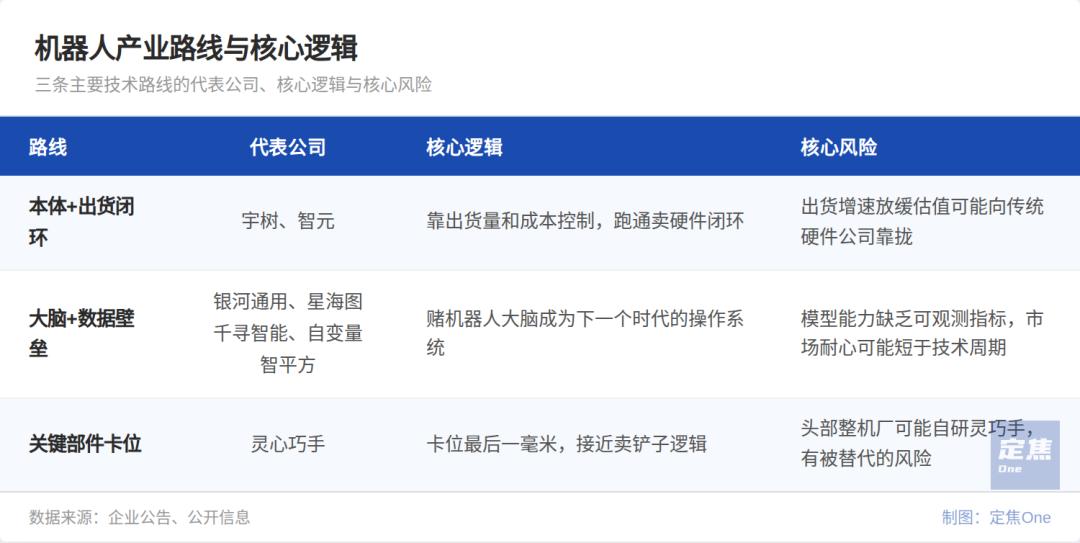
国内具身智能产业正在加速聚集。截至2026年6月,宇树科技、智元机器人、银河通用、星海图、千寻智能、自变量机器人、智平方和灵心巧手等8家公司估值已达200亿元,形成了行业内的"200亿俱乐部"1。这些企业采取了迥然不同的商业路线,在硬件出货、数据积累和落地应用上展开竞争。
硬件出货成为部分头部企业的主要竞争力。智元机器人于2026年3月成为国内首个累计下线破万台的具身智能公司1,2025年全年营收突破10.5亿元,其人形机器人在全球市场占有约39%的份额,全年出货量达5168台1。宇树科技2025年营收达16.99亿元、扣非净利润5.9亿元1,纯双足人形机器人出货量为5500台1,已通过科创板IPO注册,发行估值约420亿元1。智元已于2026年7月启动赴港上市流程1。
应用落地的差异化路径正在显现。宇树的人形机器人收入中,科研教育客户贡献了73.6%,工业应用仅占9%1。相比之下,其他企业已在实际产线中探索24小时连续运作的模式:银河通用的Galbot S1在宁德时代电池工厂实现7×24小时连续作业,稳定运行超过3个月1;千寻智能的机器人"小墨"在同一产线的单日工作量达到人工的三倍1。自变量机器人于2026年3月与58到家合作,在深圳推出"人机协同"智能保洁服务,定价为149元/3小时1。
数据资产积累成为未来竞争的关键。宇树开源了包含340小时、189万条动作轨迹的UnifoRob-WBT-Dataset1,智元旗下觅蜂科技计划在2026年实现千万小时级数据产能1。
As of June 2026, eight domestic embodied AI companies have reached valuations of 20 billion yuan, forming what is being called the "20-Billion Club"1. These firms—including Unitree Robotics, Zhiyuan, and Galaxy Universal—represent distinct strategic approaches to the emerging sector, each betting different pathways to commercialize embodied intelligence.
The eight companies pursue three primary value creation models1. Unitree and Zhiyuan lead the "hardware shipment faction," prioritizing production volume and market penetration. Zhiyuan became China's first embodied AI company to deliver over 10,000 units cumulatively in March 2026, and launched its Hong Kong IPO process in July1. Unitree achieved 16.99 billion yuan in 2025 revenue with 5.9 billion yuan in non-GAAP net profit, and has passed registration on the Shanghai Science and Technology Innovation Board at an estimated valuation of approximately 420 billion yuan1. The company shipped 5,500 pure bipedal humanoid robots in 2025, while Zhiyuan shipped 5,168 units, representing approximately 39 percent of global market share1. Zhiyuan's 2025 revenue exceeded 10.5 billion yuan1. In contrast, Galaxy Universal and related firms champion the "brain plus data" approach, leveraging software and datasets as competitive moats.
Real-world deployment scenarios are beginning to emerge across manufacturing and service sectors. Unitree's bipedal robots generated 73.6 percent of revenue from scientific research and education customers in the first three quarters of 2025, with industrial applications accounting for only 9 percent1. Qianxun Intelligence's robot "Xiaomo" performs three times the daily workload of human workers on CATL battery production lines1, while Galaxy Universal's Galbot S1 achieved continuous 24/7 operation at a CATL battery factory, running stably for over three months1. Beyond manufacturing, Zibianliangbot partnered with 58.com in March 2026 to launch "human-machine collaborative" intelligent cleaning services in Shenzhen at 149 yuan per three hours1. Data infrastructure development is also advancing: Unitree released the UnifoRob-WBT-Dataset containing 340 hours and 1.89 million action trajectories1, while Zhiyuan's subsidiary Mifeng Technology plans to achieve data production capacity at the scale of tens of millions of hours by 20261.
评论
还没有评论,欢迎留下第一条。