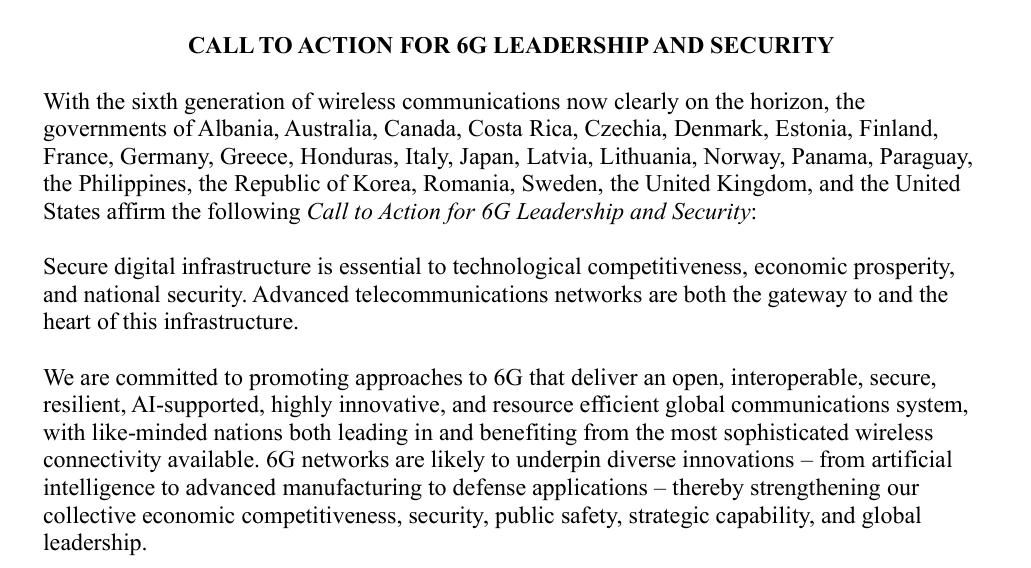
美国国家电信和信息管理局于7月27日宣布,与英国、德国、日本、澳大利亚、加拿大、法国等共24个国家启动全球6G合作计划1。这一举措旨在加快安全6G无线网络的开发并为商业部署做准备1。
参与合作的各国达成共识,认为未来6G网络应具备开放、可互操作、安全、韧性强和AI支持等特征1。该合作涵盖标准、研发、市场准入、安全与频谱等多个方面1。鉴于6G预计在2030年前后进入商用阶段1,美国此举实际上是在标准尚未定型之际,通过提前布局规则体系,重新定义6G竞争场域。
这一全球合作框架的形成,意味着中国物联网企业将面临新的挑战,包括从被动跟踪标准转变为主动用场景定义标准、将安全合规要求前置到产品设计阶段,以及建立国际认证能力等多方面的适应与升级1。
The U.S. National Telecommunications and Information Administration announced on July 27 a global 6G cooperation initiative involving 24 countries, including the United Kingdom, Germany, Japan, Australia, Canada, and France 1. The collaborative framework aims to accelerate the development of secure 6G wireless networks and prepare for commercial deployment 1.
The participating nations have reached consensus that future 6G networks must embody open, interoperable, secure, resilient, and AI-enabled characteristics 1. The cooperation spans multiple domains including standards development, research and development, market access, security, and spectrum coordination 1. This strategic alignment positions participating countries to shape 6G competition before formal standards are finalized, with commercial deployment anticipated around 2030 1.
Chinese Internet of Things enterprises face mounting challenges amid this coordinated approach, including the need to transition from tracking international standards to defining standards through use cases, incorporating security and compliance requirements into product design from inception, and developing international certification capabilities 1.
评论
还没有评论,欢迎留下第一条。