根据IT桔子数据,截至2026年7月中国新增73家独角兽企业,估值总额达1905亿美元1。本轮独角兽涌现主要集中在AI和机器人领域,两个赛道合计38家,占比超过52%1。
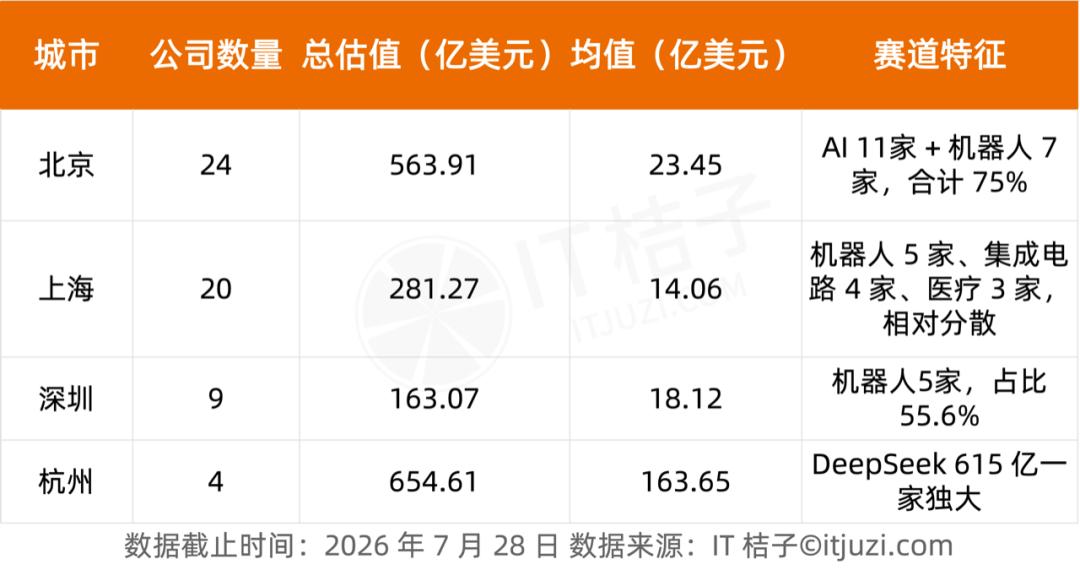
地理分布上,北京24家新独角兽领跑全国,总估值563.91亿美元,其中18家注册在海淀区,贡献北京85%的估值1。这18家海淀新独角兽呈现出独特的孵化生态:至少10家创始人或核心团队拥有清华大学背景,至少10家创始人或核心团队来自大厂或头部企业,其中字节系最为密集,占4家1。2026年海淀区中关村科学城还新发布合计100亿元的基金支持,包括80亿元科技成长四期基金和20亿元科技成果转化基金1。"高校+大厂+早期创投"三重叠加的孵化模式,支撑了这一轮独角兽的快速增长。
其他城市方面,上海20家新独角兽总估值281.27亿美元,主要采用"大厂拆分"模式1;深圳9家新独角兽中5家为机器人企业,合计估值163.07亿美元1;杭州4家新独角兽总估值654.61亿美元,其中DeepSeek一家企业贡献615.38亿美元1。
China added 73 new unicorn companies by mid-2026, with a combined valuation of $19.05 billion, according to data from IT Juzi 1. The wave of newly minted unicorns is dominated by artificial intelligence and robotics, which together account for more than 52% of the cohort 1.
Beijing leads geographically with 24 new unicorns valued at $563.91 million, though the concentration is even sharper within Haidian District, which hosts 18 of these companies and contributes 85% of Beijing's valuation 1. At least 10 of Haidian's 18 new unicorns have founders or core team members with Tsinghua University backgrounds 1. The district has also become a hub for major tech companies and venture capital, with ByteDance being the most prevalent among founders with prior big-tech experience—four of the new unicorns trace back to ByteDance 1. In 2026, Haidian's Zhongguancun Science City launched two funds totaling 10 billion yuan, comprising an 8 billion yuan technology growth fund and a 2 billion yuan technology commercialization fund 1.
Other major innovation hubs show distinct patterns. Shanghai's 20 new unicorns, valued at $281.27 billion, predominantly emerged through spin-offs from established tech companies 1. Shenzhen's 9 new unicorns include 5 robotics companies with a combined valuation of $163.07 billion 1. Hangzhou's 4 new unicorns carry a valuation of $654.61 billion, though this is heavily skewed by DeepSeek, which alone accounts for $615.38 billion 1.
评论
还没有评论,欢迎留下第一条。