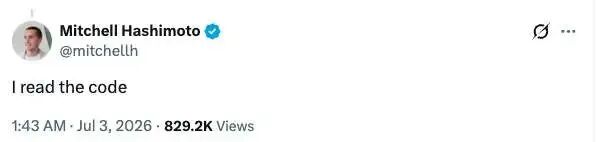
围绕人工智能生成代码是否需要逐行阅读,编程界近日陷入激烈争论。1HashiCorp联合创始人Mitchell Hashimoto发推文主张"I read the code",获得近83万次浏览,强调开发者应当审查代码;1而资深开发者Uncle Bob则提出对立观点,称"完全不去读Agent写出来的任何代码",该言论获得超480万次浏览。1这场论战反映了AI时代代码生成成本下降后,开发工作方式的根本转变。1
Uncle Bob的核心主张是用约束和验证体系替代人工审查。1他提出的策略包括设置单元测试、Gherkin测试、QA流程、质量指标和变异测试等严格机制,而非逐行审查代码。1Uncle Bob认为代码质量仍然至关重要,混乱的代码会降低AI Agent本身的工作效率。1
对此,开发者Cindy Sridharan表达了担忧,指出"每当听见有人说代码全是Claude写的、自己不知道工作原理,我就认定这个人根本没有能力调试这些代码"。1另一位开发者Christine Lemmer-Webber提出"Vibe滑坡"现象:随着生成速度的增加,代码审查逐步被放松。1而Theo创始人则持不同看法,认为大多数工程师的代码阅读比例过高,应当从AI生成代码中获得更多价值。1
A significant debate has emerged within the development community regarding whether programmers should carefully review code produced by artificial intelligence systems. Mitchell Hashimoto, co-founder of HashiCorp, posted on social media advocating for the position "I read the code," emphasizing developer responsibility for understanding generated code, garnering approximately 830,000 views as of July 3 1. This stance prompted a contrasting response from veteran developer Robert C. Martin, commonly known as Uncle Bob, who declared "I don't read any code written by agents at all," a post that achieved over 4.8 million views 1.
Uncle Bob's alternative approach centers on establishing rigorous safeguards rather than relying on manual code review 1. His proposed framework includes implementing comprehensive unit tests, Gherkin-based testing, quality assurance processes, quality metrics, and mutation testing to verify code integrity 1. This methodology reflects a fundamental shift in development practices as artificial intelligence reduces the cost of code generation 1. Other industry voices have contributed to the discussion, with Cindy Sridharan arguing that developers claiming "all code is written by Claude and I don't know how it works" demonstrate an inability to debug such code 1. Christine Lemmer-Webber identified what she termed a "vibe slope" phenomenon, where increased development speed correlates with reduced code review rigor 1. Despite these differing perspectives, Uncle Bob maintains that code quality remains important, as he believes poorly structured code diminishes the efficiency of AI agents themselves 1. Theo's founder has suggested that most engineers spend too much time reading code and should extract greater value from AI-generated solutions 1.
评论
还没有评论,欢迎留下第一条。