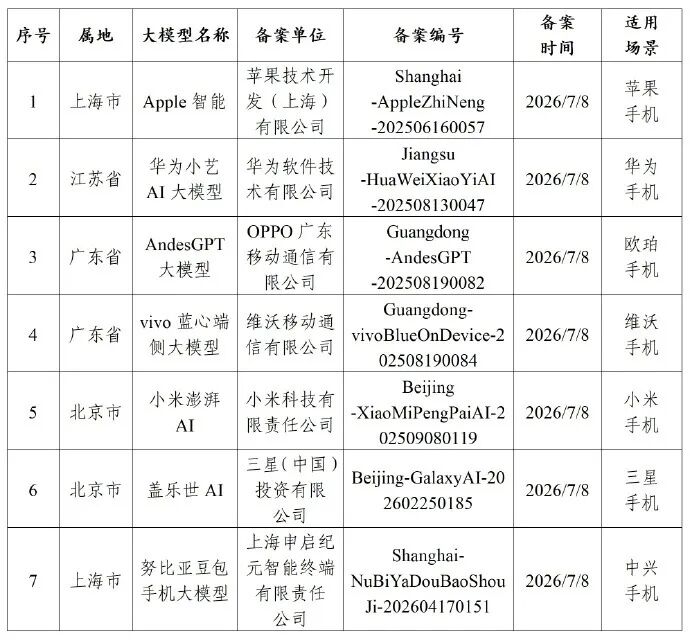
7月15日,国家网信办首次为手机端侧AI单独开放备案渠道,苹果智能、华为小艺、OPPO AndesGPT等7款大模型获得备案资格1。同日,《人工智能拟人化互动服务管理暂行办法》正式实施,推动行业从情感陪伴型AI向任务执行型AI Agent转变,字节豆包、阿里千问等随之下线部分情感陪伴功能1。这一系列政策调整为AI手机产业明确了发展方向。
市场需求空间巨大。Counterpoint预测2026年搭载生成式AI的智能手机将占全球出货量的45%,到2027年这一比例将升至52%1。在中国市场,IDC预计2026年新一代AI手机出货量将达1.47亿台,同比增长31.6%,占整体市场53%1。随着市场扩张,芯片成本也在上升,二季度DRAM合约价环比涨超50%,NAND涨幅接近75%1。
为抢占入口控制权,各厂商采取了差异化的技术路线。荣耀推出Robot Phone,在机身顶部加入四自由度钛合金机械云台,并推出AgenticOS操作系统1。阶跃星辰发布的STEPX Neo采用原生智能体操作系统Step AOS,是唯一通过《人工智能终端智能化分级》L3最高等级认证的智能体手机1。努比亚NaviX Ultra联合字节豆包,采用A2A/MCP协议与超级APP深度集成1。围绕硬件形态、操作系统和生态协议的差异竞争,正在重塑智能手机产业格局。
China's regulatory landscape for artificial intelligence on mobile devices shifted significantly on July 15, when the Cyberspace Administration of China approved dedicated registration for on-device AI models for smartphones for the first time.1 Seven large language models, including Apple Intelligence, Huawei Xiaoyi, and OPPO AndesGPT, received clearance on the same day.1 Concurrently, the "Interim Measures for the Management of Anthropomorphic AI Interactive Services" came into effect, prompting platforms like ByteDance's Doubao and Alibaba's Qwen to discontinue certain emotional companion features.1
This regulatory shift reflects a broader industry transition from emotion-focused AI companions toward task-execution AI agents. Market forecasts underscore the momentum behind this transition: Counterpoint Research predicts that generative AI-enabled smartphones will represent 45% of global shipments by 2026, rising to 52% in 2027.1 Within China specifically, the International Data Corporation projects that new-generation AI phone shipments will reach 147 million units in 2026, a year-over-year increase of 31.6%, accounting for 53% of the overall market.1 Supporting this growth, memory component prices have surged, with DRAM contract prices climbing over 50% quarter-over-quarter and NAND prices rising nearly 75%.1
Competing device manufacturers are pursuing divergent technical approaches to establish market dominance. Honor unveiled the Robot Phone, featuring a four-degree-of-freedom titanium alloy mechanical gimbal atop the device and its proprietary AgenticOS operating system.1 Aesir Labs released the STEPX Neo, employing a native intelligent agent operating system called Step AOS and standing as the only agentic smartphone certified at the highest L3 level under the "AI Terminal Intelligence Classification Standard."1 Nubia's NaviX Ultra integrates with ByteDance's Doubao platform through A2A and MCP protocols, achieving deep integration with super-apps.1
评论
还没有评论,欢迎留下第一条。