2026年11月24日,一组展示双小行星系统发生日食现象的照片被发布为当日太空摄影精选 1。欧洲空间局(ESA)的“赫拉”(Hera)探测器对Didymos和Dimorphos双小行星系统进行了详细调查,捕捉到了独特的日食景象以及揭示热力学特性的红外图像 1。这些影像展示了小行星碰撞后的损伤情况及肉眼不可见的冷却过程 1。此次观测旨在评估人为改变小行星轨道以保护地球的技术效果,即检查NASA“双小行星重定向测试”(DART)任务撞击造成的损害情况 2。
赫拉探测器已抵达小行星迪莫弗斯(Dimorphos),并发回了首批撞击后的高清近距离图像 34。图像显示,由人类首次行星防御测试留下的陨石坑具有体育场大小 456。Ars Technica报道指出,这些由Hera的Hyperscout-H仪器于2024年11月6日在距离小行星约29.9公里处拍摄的图像,揭示了汽车大小的撞击器在直径约151米的Dimorphos上凿出的巨大坑洞 7。科学家Patrick Michel表示:“实际上我们两者都做到了,因为撞击坑非常大,以至于形状发生了改变。” 7 Sabina Raducan也指出:“我们立刻知道撞击成功了……但我们仍然不知道是什么样的混乱。” 7 赫拉发现大量巨石环绕该小行星系统,证实了DART撞击产生的碎片规模远超预期,且Michael Kueppers称Dimorphos在其轨道中剧烈翻滚 7。
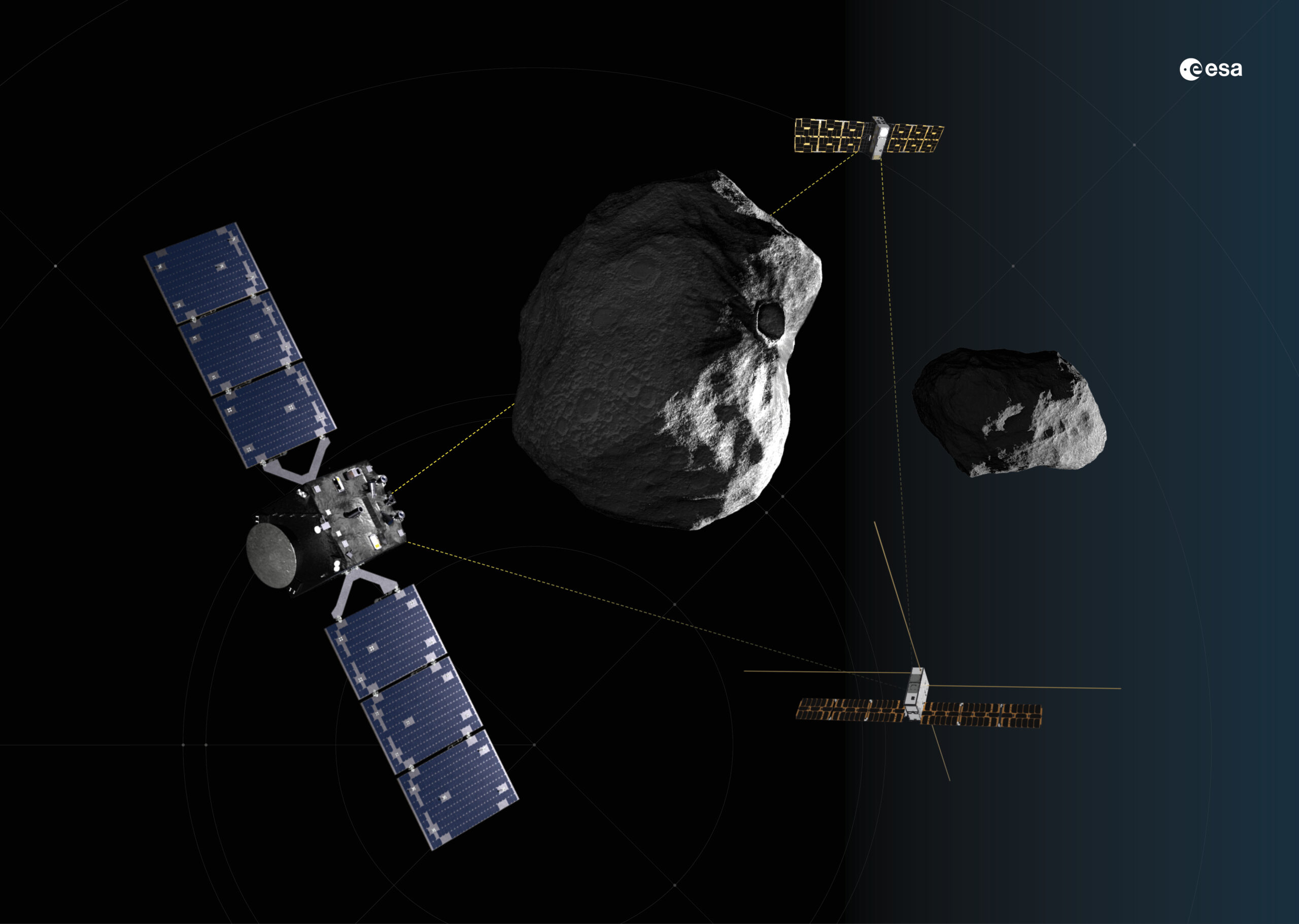
BBC World报道称,NASA此前公布了2022年故意撞击小行星Dimorphos后的首批图像,确认其表面形成了体育场大小的陨石坑 8。此次撞击是测试行星防御能力、验证能否使太空岩石偏离轨道的实验 8。四年后,欧洲空间局的“赫拉”号飞船正在现场评估撞击造成的后续影响 8。赫拉任务将在未来六个月内飞得更近,并释放两个名为Juventas和Milani的小型立方星尝试着陆Dimorphos,以收集数据完善未来偏转威胁地球小行星的模型 7。多家媒体包括Yahoo Tech、BBC、Space.com、CNN、The Guardian和NYT对此事件及直播预告进行了报道 24。
On November 24, 2026, a selection of photographs capturing a double asteroid solar eclipse was released as the space photo of the day 1. These images were taken by the European Space Agency’s (ESA) Hera spacecraft during its detailed investigation of the Didymos-Dimorphos binary asteroid system 1. The release coincides with broader unveilings of close-up imagery showing the aftermath of NASA’s Double Asteroid Redirection Test (DART), marking a significant milestone in planetary defense research 234.
The newly revealed images provide the first detailed look at the damage inflicted on the moonlet Dimorphos by the deliberate collision with NASA’s DART mission in September 2022 25. This impact, recognized as humanity’s first test of asteroid deflection technology, created a crater approximately the size of a sports stadium on the surface of Dimorphos, which is roughly 500 feet (151 meters) in diameter 467. Scientific analysis indicates that the kinetic impactor struck at speeds exceeding 13,700 miles per hour (6.14 kilometers per second), releasing about 10 billion joules of energy 7. The collision successfully altered the moonlet’s orbit around the larger asteroid Didymos, shortening its 12-hour orbital period by approximately 33 minutes—a result 25 times greater than conservative expectations 7.
Hera’s observations have uncovered unexpected complexities in the post-impact environment, including hundreds of boulders of varying sizes moving around the binary system 7. Patrick Michel, an ESA scientist involved in the mission, noted that the impact not only created a large crater but also fundamentally changed the shape of the asteroid due to the scale of the destruction 7. Sabina Raducan stated that while the success of the impact was immediately known, the extent of the resulting chaos remained unclear until these recent observations 7. Additionally, Michael Kueppers reported that Dimorphos is now tumbling violently within its new orbit 7.
These initial images were captured by Hera’s Hyperscout-H instrument from a distance of about 29.9 kilometers (18.6 miles) on November 6, 2024 7. Infrared data included in the latest releases reveals thermal properties and cooling processes invisible to standard cameras 1. The spacecraft continues its mission to assess the physical state of the asteroids and evaluate the effectiveness of changing an asteroid's trajectory to protect Earth 28. Over the next six months, Hera plans to move closer to the target and deploy two small CubeSats named Juventas and Milani to attempt landing on Dimorphos for further data collection 7. This ongoing investigation aims to refine models for future planetary defense strategies against potential threats to our planet 67.
评论
还没有评论,欢迎留下第一条。