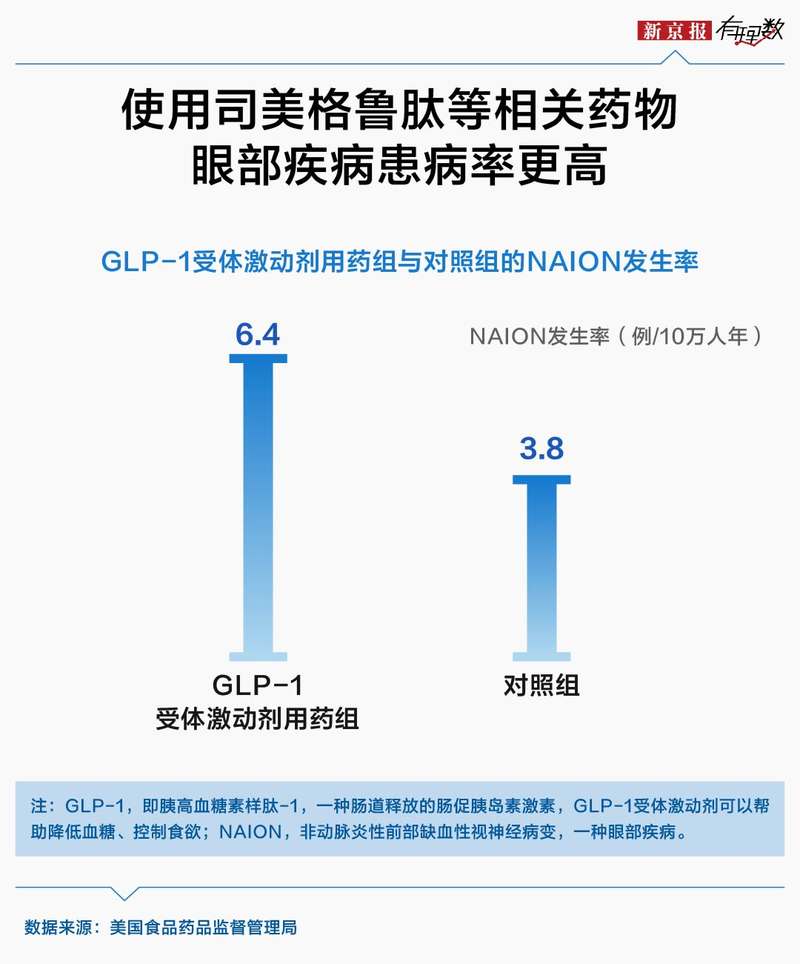
美国食品药品监督管理局发布通告,指出GLP-1受体激动剂类药物可能增加罕见眼病“非动脉炎性前部缺血性视神经病变”(NAION)的风险,严重时可能导致失明 1。该通告点名了司美格鲁肽和替尔泊肽 1。试验数据显示,使用该类药人群中NAION发生率为每10万人年6.4例,未使用对照组为3.8例 1。
2024年6月,中国国家药品监督管理局批准用于长期体重管理的司美格鲁肽注射液“诺和盈”上市 1。某三甲医院数据显示,2023年7月至2024年6月,由减重门诊开具的司美格鲁肽处方占同期该院该药门诊处方的30.32% 1。一项327人的研究显示,用药第68周平均减掉初始体重的17.3%,但停药随访至第120周回升11.6个百分点,最终仅比用药前低5.6% 1。
The U.S. Food and Drug Administration (FDA) has issued a safety alert regarding GLP-1 receptor agonist medications, specifically naming semaglutide and tirzepatide, warning that these drugs may increase the risk of a rare eye condition known as nonarteritic anterior ischemic optic neuropathy (NAION), which can result in blindness 1. Clinical trial data indicates that the incidence rate of NAION among users of these medications is 6.4 cases per 100,000 person-years, compared to 3.8 cases in the untreated control group 1.
In China, the regulatory landscape for these weight-management drugs has recently shifted, with the National Medical Products Administration approving semaglutide injection under the brand name "Nuoheling" for long-term weight management in June 2024 1. The demand for such prescriptions outside of diabetes treatment remains high; data from a top-tier hospital shows that between July 2023 and June 2024, 30.32% of all outpatient semaglutide prescriptions were issued by weight-loss clinics 1. However, concerns persist about the sustainability of results, as a study involving 327 participants found that while patients lost an average of 17.3% of their initial body weight by week 68 of treatment, they regained 11.6 percentage points of that weight by week 120 after discontinuing the medication, ending up only 5.6% lighter than their starting weight 1.
评论
还没有评论,欢迎留下第一条。