36氪研究院发布《2026年中国智能硬件行业发展研究报告》,揭示了中国智能硬件产业的最新发展态势。1报告指出,中国智能硬件已进入AI原生发展初期,行业核心竞争力正从硬件参数指标逐步转向端侧AI体验。1根据腾讯研究院2026年3月调研数据,80.8%的国内消费者已购买或使用过AI相关硬件产品,其中32.0%的用户表示将在未来三个月增加相关消费支出。1
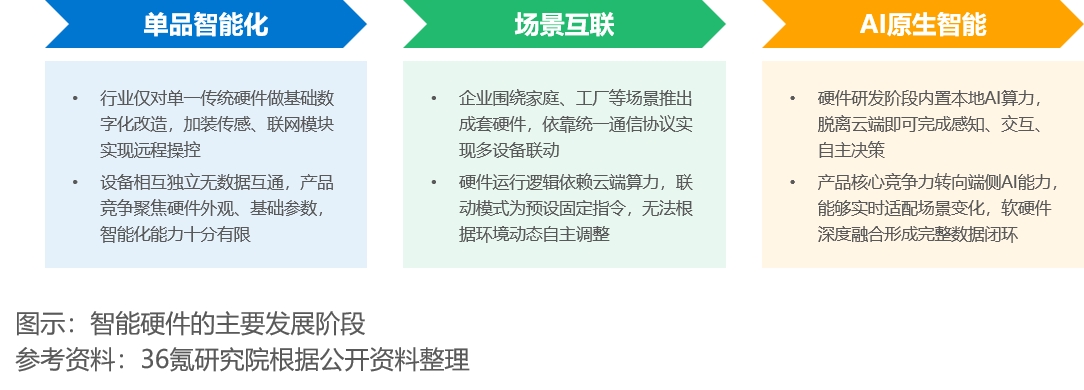
产业链上中下游正围绕本地自主智能能力进行协同升级,整个行业正从场景互联向AI原生智能阶段过渡。1在新的发展阶段,智能机器人成为跨越B端和C端的增长新物种,人形机器人迈入放量前夕,而出海业务成为产业的新增长引擎。1
36Kr Research Institute has published the "2026 China Smart Hardware Industry Development Report," identifying that China's smart hardware sector has entered an early stage of AI-native development, with core competitive advantages shifting from hardware specifications to on-device AI experiences 1. According to research data from March 2026, the report reveals that 80.8% of domestic consumers have already purchased or used AI-related hardware products 1, with 32.0% of users indicating they plan to increase spending on such products over the next three months 1.
The research indicates that industry stakeholders across the supply chain—from upstream to downstream—are coordinating upgrades focused on localized autonomous intelligence capabilities 1. Smart robots have emerged as a significant growth engine spanning both business-to-business and business-to-consumer segments, with humanoid robots approaching a phase of mass production 1. This transition marks a broader shift in the sector from scenario-based interconnection toward AI-native intelligence architecture 1.
评论
还没有评论,欢迎留下第一条。