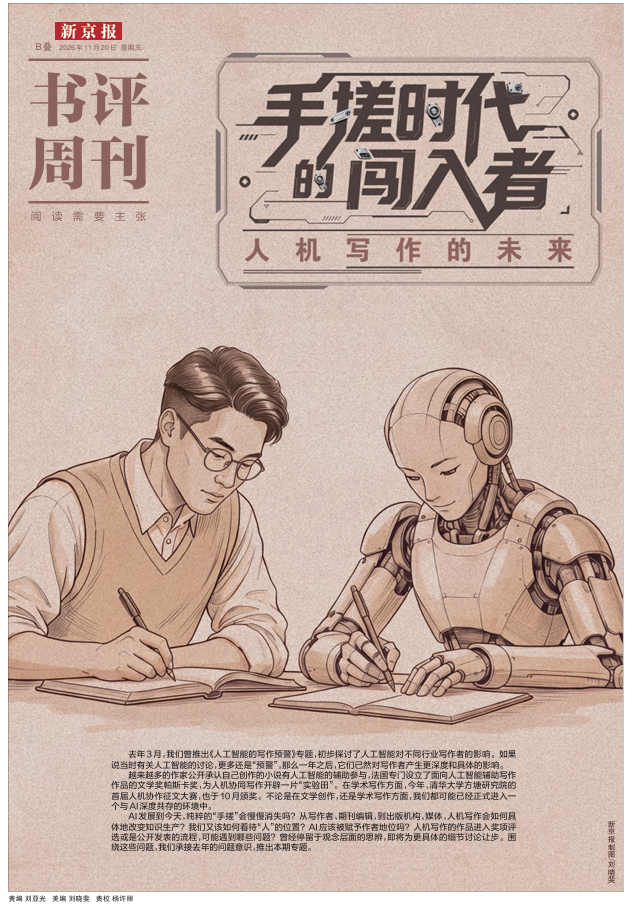
新京报对学者徐贲进行了深度专访,探讨人工智能时代下人文研究与知识生产面临的变革与挑战 1。徐贲认为,“手搓”式纯人类写作正逐渐消失,他呼吁公开承认AI参与,而非通过检测工具进行道德表演 1。文章分析了AI在思辨类与田野调查类研究中的不同作用,指出过度依赖AI可能削弱年轻学者的判断力基础 1。
在具体的学术实践层面,徐贲提出了“学徒悖论”,即最需要AI帮助的低阶使用者往往最缺乏判断AI输出质量的能力,而高阶共笔主要利好资深学者 1。对于人类学、社会学等依赖具身经验的学科,他指出AI难以替代田野调查中的情感连接与情境感知,且可能扁平化文化“深描” 1。他反对防御性禁止AI写作,认为这会导致“用AI查AI痕迹”的荒谬循环,使诚实披露成为风险,鼓励地下使用 1。此外,徐贲主张出版界应从内容把关转向建立信任基础设施,以应对AI带来的知识公共性挑战 1。
针对这一趋势,业界已出现一些探索案例。法国设立了面向AI辅助写作的文学奖“帕斯卡奖”,清华大学方塘研究院也举办了人机协作征文大赛 1。徐贲还引用了心理学家安吉拉·达克沃斯(Angela Duckworth)的案例,她在宾夕法尼亚大学毕业典礼上承认演讲由AI协助完成且不感到羞愧,以此佐证坦诚面对技术介入的态度 1。
In a recent interview with Beijing News In-Depth, scholar Xu Ben argued that traditional, purely human-led writing in the humanities is gradually disappearing amid the rise of artificial intelligence 1. He called for transparency regarding AI involvement in knowledge production rather than relying on detection tools, which he described as a form of moral performance 1. Xu posited that defensive prohibitions against AI writing create an absurd cycle where authors use AI to detect AI traces, effectively turning honest disclosure into a risk and encouraging underground usage 1.
Xu highlighted what he termed the "apprentice paradox," noting that junior researchers who most need AI assistance often lack the critical judgment to evaluate its output quality, whereas high-level co-writing primarily benefits senior scholars 1. This dynamic raises concerns that over-reliance on technology may erode the foundational judgment skills of younger academics 1. While AI can support speculative reasoning, Xu emphasized that it cannot replace the embodied experience required in disciplines like anthropology and sociology, particularly the emotional connections and situational awareness central to fieldwork 1. He warned that AI might flatten the cultural "thick description" essential to these fields 1.
To address these challenges, Xu suggested that the publishing industry should shift its role from being content factories to becoming infrastructure for trust 1. This transformation involves focusing on verification, accountability, and error correction mechanisms rather than simply selling text 1. The article noted emerging initiatives such as France’s Pascal Prize for AI-assisted writing and Tsinghua University’s Fangtang Research Institute competition for human-machine collaboration 1. Citing psychologist Angela Duckworth, who admitted at her University of Pennsylvania graduation speech that it was aided by AI without feeling shame, Xu illustrated how public acknowledgment of AI tools can be normalized 1.
评论
还没有评论,欢迎留下第一条。