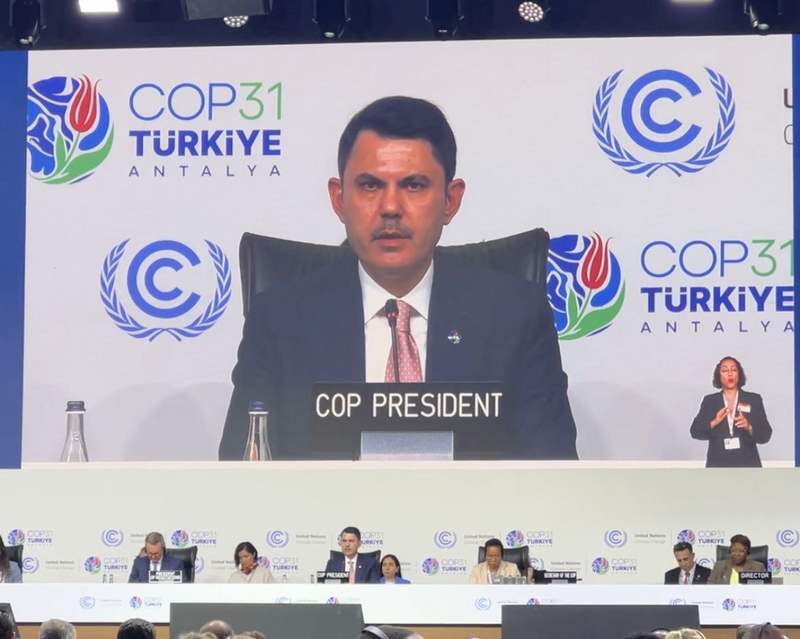
在土耳其安塔利亚举行的第31届联合国气候变化大会(COP31)因各国在化石燃料条款及气候融资问题上存在严重分歧,未能按期达成协议,谈判进入加时阶段。123 会议原定于2026年11月20日周五15:00 GMT结束,但因最后文本悬而未决而延长,截至当地时间11月21日,加时已持续超过20小时。23 最终协议预计将于周六发布。1
核心冲突在于新草案删除了所有关于逐步淘汰或减少化石燃料需求的提及,引发了以法国和巴拿马为首的集团强烈反对。12 巴拿马环境部长Juan Carlos Navarro直言:“让一份连化石燃料都不提及的COP决议或封面决定是不可接受的,我们绝不会忍受。”1 法国生态转型部长Monique Barbut则批评碳捕获技术被用作继续燃烧石油和天然气的借口。1 为寻求妥协,有提议通过不提及化石燃料来换取沙特阿拉伯等产油国签署承诺,即到2035年其电力结构的35%来自清洁电力。1 这一“35-by-35”电气化目标得到了中国和澳大利亚的支持,两国联合声明支持自愿将电力在全球最终能源消费中的占比从目前的约20%-23%提高到2035年的35%。2 然而,澳大利亚气候部长Chris Bowen承认草案未指定供应电力的具体能源来源,强调“电气化是摆脱化石燃料的关键”。2 秘鲁代表团团长Andres Martin Garrido Sanchez指责地缘政治分裂阻碍了实质性进展,并点名海湾阿拉伯国家和俄罗斯为主要反对者。2 值得注意的是,本次谈判首次正式承认1.5°C升温目标已失守,世界进入“overshoot”时期。1
资金安排是另一大争议焦点,早前文本中提到的到2035年将适应资金增加到每年至少1200亿美元的计划已被移除,仅保留模糊表述。13 非洲国家对此表示强烈不满,加纳环境部长Zanetor Agyeman Rawlings指出:“我们不是来乞讨的,我们是来主张我们的人民理应得到的权利,他们正承受发达国家人为活动带来的冲击。”1 联合国环境规划署《2026年适应差距报告》显示,到2035年发展中国家每年适应资金需求预计达约3050亿美元,即便按1200亿美元计算也只能覆盖不到三成。3 此外,根据《公约》秘书处官方报告,发达国家整体排放从2020年到2030年呈上升趋势,且无发达国家能实现2030年减缓目标,美国退出《巴黎协定更造成资金缺位,加剧了各方信任裂痕。3 美国总统特朗普连续第二年未派遣正式代表团参加气候谈判,称全球变暖为“骗局”,由议员、市长和州长组成非官方代表团出席。2
埃塞俄比亚外交部长Gedion Timothewos确认将主办下一届COP32,并将其比作接力赛而非短跑。2
Negotiations at the 31st UN Climate Change Conference (COP31) in Antalya, Turkey, have reached a deadlock, forcing the summit into overtime as delegates fail to agree on a final text regarding fossil fuel reduction and climate finance 123. The original closing date of November 20, 2026, has passed, with talks extending more than 20 hours past schedule without a resolution 23. A draft agreement that was expected to be released on Saturday remains elusive due to deep divisions between nations demanding explicit language on phasing out fossil fuels and those opposing such commitments 12.
Clashes Over Fossil Fuel Language
The core contention arises from a new draft that completely removed references to reducing demand for or phasing out fossil fuels, a move heavily criticized by environmental groups and several national delegations 12. Panama’s Environment Minister Juan Carlos Navarro declared this unacceptable, stating, "It is not acceptable to have a COP or a cover decision that does not even mention fossil fuels and we simply will not put up with it" 1. This position is supported by a bloc including France and multiple EU nations such as Spain, Belgium, Sweden, and Finland 1. French Ecological Transition Minister Monique Barbut further argued that carbon capture technologies are being misused as a pretext to continue burning oil and gas 1. Conversely, China and Australia jointly endorsed a voluntary "35-by-35" electrification plan, aiming to raise the share of electricity in global final energy consumption from roughly 20%-23% to 35% by 2035 2. Australian Climate Minister Chris Bowen emphasized that "electrification is key to getting off fossil fuels," though he acknowledged the draft does not specify the energy sources for this electricity 2. Peru’s delegation head Andres Martin Garrido Sanchez attributed the lack of substantive progress to "geopolitical division," identifying Gulf Arab states and Russia as primary opponents to language addressing dependence on oil, gas, and coal 2. Notably, the United States did not send an official delegation; President Trump has called global warming a "hoax," and only unofficial representatives such as mayors and state governors attended 2. A potential compromise floated during negotiations involved omitting direct fossil fuel mentions in exchange for commitments from oil-producing nations like Saudi Arabia to ensure 35% of their electricity comes from clean sources by 2035 1.
Finance and Trust Deficits
Disagreements over adaptation funding have further eroded trust between developed and developing nations. The second version of the draft, circulated on November 19, deleted the specific target from the first version to increase annual adaptation finance to at least $120 billion by 2035 3. Ghana’s Environment Minister Zanetor Agyeman Rawlings expressed frustration with the financial stance of wealthy nations, asserting, "We did not come here to beg we came here to claim what is rightfully ours for our people who are suffering the brunt of anthropogenic activities of developed countries" 1. According to the UNEP Adaptation Gap Report 2026, developing countries’ annual adaptation needs are projected to reach approximately $305 billion by 2035, meaning even the previously proposed $120 billion target would cover less than 30% of requirements 3. Official reports from the Convention Secretariat indicate that emissions from developed countries rose between 2020 and 2030, with none meeting their 2030 mitigation targets 3. Additionally, the US withdrawal from the Paris Agreement has created significant gaps in promised climate finance 3.
Overshoot Acknowledgment and Future Hosting
In a historic shift, the negotiations marked the first time the international community formally acknowledged that the 1.5°C warming limit has been breached, signaling that the world has entered a period of "overshoot" 1. Amid the ongoing procedural impasse, Ethiopia confirmed it will host the next conference, COP32 2. Ethiopian Foreign Minister Gedion Timothewos described the multilateral process as a "relay race rather than a sprint," emphasizing the need for sustained effort despite current setbacks 2.
评论
还没有评论,欢迎留下第一条。